Oxford Script Awards OxfordScript Awards

Producer access

2026 Producer Pitch

Share your background, writing experience, awards, produced credits, and the stories you are passionate about telling. Use this space to present your creative voice, highlight your strongest projects, and explain what makes your work unique. This is your opportunity to attract potential collaborators and showcase the screenplays currently available for development or production.

From logline to the author’s inbox

  • Lavender

    Isabela Augustas46 pages

    A portrait of a family at a particular moment in their lives: Struggling to close a chapter in one's life in order to move to the next. Hopelessly trying to escape a prison of one's own making. Facing an overdue moment of reckoning. And discovering the ugliest of characters underneath a flawless exterior.

    Read the full pitch

    Short synopsis

    LAVENDER is a stage play which takes place over one evening and portrays a family in domestic hell that simmers underneath a perfect exterior.

    We find VERA, somewhat cold and distant as a way of survival, in her family home she shares with her husband ROBERT, trying to ready herself for an evening she considers to be the final curtain on their marriage. Unfortunately, her husband disagrees; although a man of striking presence and personality, a profound lack of empathy dictates his every relationship. His bullying this evening is directed at ANTON, his younger brother, an unhappy man who has developed a somewhat unhealthy attachment to VERA. They are also joined by HELENA, daughter of ROBERT and VERA, a spoiled young woman with strong sense of entitlement which makes her truly her father's daughter.

    As the evening progresses the thin veneer of family bonds begins to fade. Emotionally distant and cleverly using manipulation and self-pity, it is evident that each of the four characters is acting solely to advance his or her agenda.

    Comps (comparisons)

    Henrik Ibsen's A Doll's House, Harold Pinter's Betrayal, and Yasmina Reza's God of Carnage.

    The hook

    Although the play deals with the universal theme of family, it actually explores how emotional distance, resentment and breakdown of trust can slowly turn a family into a battlefield.

    Scale / budget

    Since this is a stage play, it is closest to a micro-budget indie. There are four characters, the play takes place over one evening and the scene is a family living room.

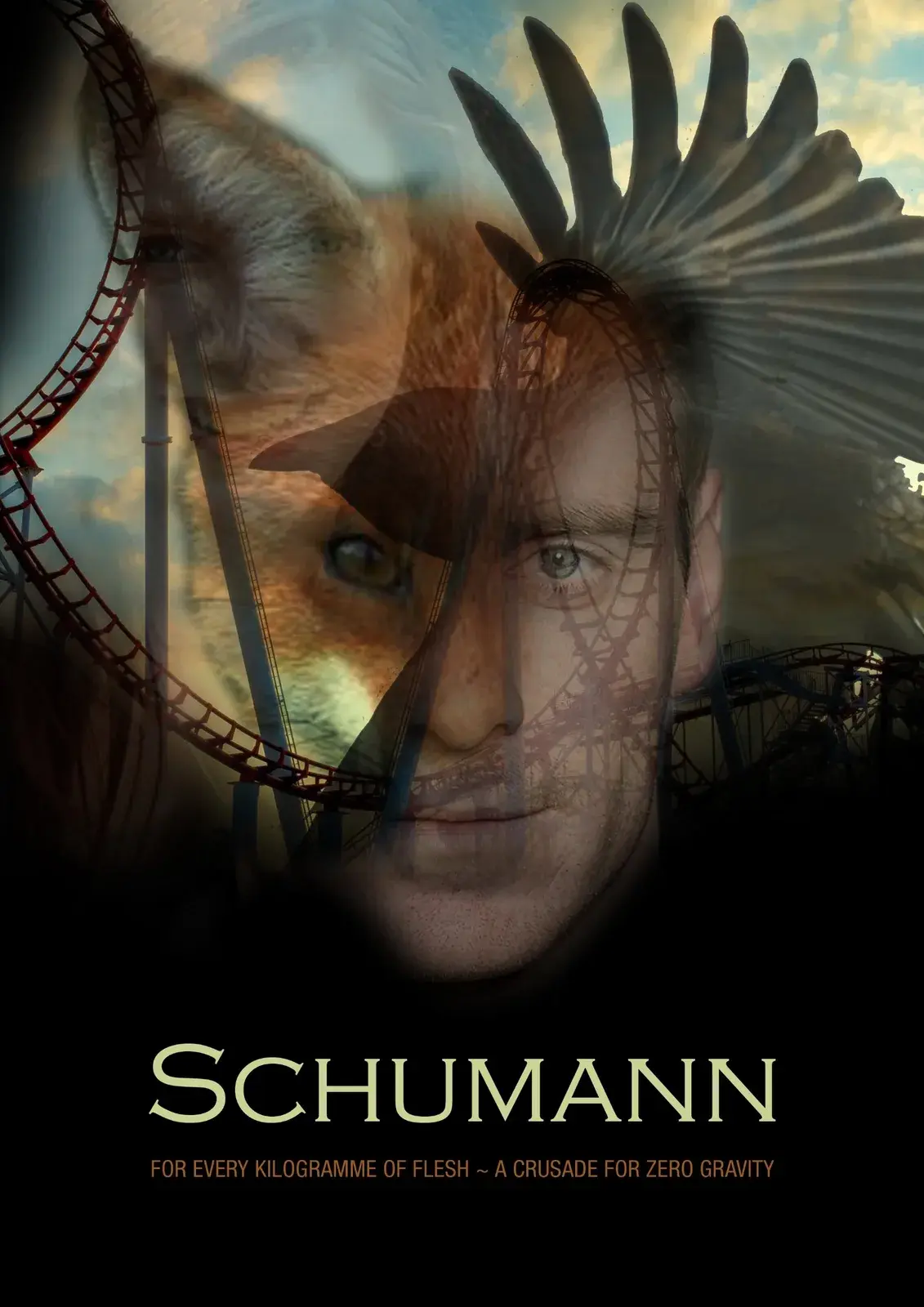
  • Poster artwork for the screenplay Schumann

    Schumann

    Steve Nethercott-Cable114 pages

    When a brilliant rollercoaster designer mysteriously vanishes, he conspires to give his thrill-addicted riders the one sensation they cannot buy… real fear.

    Read the full pitch

    Short synopsis

    Schumann, a world-renowned rollercoaster designer has created his most euphoric thrill-ride yet - Zero Gravity (ZG), incorporating a hi-tech bio-metric feedback system, which links Rider’s biochemistry via their personal bio-tattoo (‘BIO-TAT’).

    As Schumann’s disdain for his hedonistic thrill-seekers (shriekers) grows, his glowing bio-tat is a painful reminder of the monster he’s created. Schumann regularly escapes the Theme Park chaos by slipping away to a hidden cavern within the huge ZG rollercoaster mountain structure.

    Schumann despises the Theme Park’s Corporate greed which exploits shriekers’ hedonistic addictions and endangers riders’ safety. Disregard for safety is his breaking point. Haunted by the childhood car crash that killed his unbelted parents, Schumann has built his career around control and safety.

    At night Schumann secretly constructs a control room within the rollercoaster mountain structure and hard-wires controls into Theme Park Systems. He observes shriekers via surveillance video and influences ride operations, whilst remaining safely detached from the outside world.

    ZG launch day arrives and Schumann mysteriously disappears - retreating to live in his bizarre control room. Schumann’s mental health deteriorates. He survives by scavenging junk food and is physically affected by the ZG ride’s powerful electromagnetic forces, which amplify his hallucinations. Lonely Schumann communes with nocturnal wildlife and tames a wild fox. He builds a bizarre trophy collection of orphan shoes flung off by ZG’s G-forces. Animals and shoes become his safe companions.

    Zest Agency hires the Theme Park for a lavish Wrap Party, to celebrate ZG’s success. During an exhilarating preview ride on ZG, Gemma (PR Manager) loses her stiletto shoe whilst fighting off drunken advances by Matt (Marketing Manager). Schumann witnesses this fight remotely via his surveillance system. He emotionally connects with Gemma’s plight and vulnerability, attracted by her beauty and strength in the face of adversity.

    Later Schumann scavenges the stiletto shoe from the undergrowth beneath the rollercoaster. Obsessed by Gemma, he constructs a plan to entice her into his lair by promising return of her shoe.

    An intriguing union develops and their uneasy connection deepens into intimacy. However, Gemma grows alarmed to discover he is covertly controlling the ride. She regularly visits him secretly and opens a window into his soul, but this challenging romantic distraction threatens to expose his whereabouts and secret master plan to wreak revenge on the Corporation and shriekers.

    Gemma persuades Schumann he cannot build a life with her whilst imprisoned in his control room. They escape to a remote land-sailing base on Utah’s Salt Flats. Unbeknown to Gemma, Schumann has programmed a remotely-controlled thrill-ride shutdown. This is unwittingly triggered by a Ride Construction Manager, when he discovers and enters Schumann’s bizarre abandoned control room.

    Across the Theme Park, rides screech to a halt as a cacophony of screams erupt from terrified shriekers, now trapped dangling upside-down like rag dolls. Then powerful machinery resets, lurching shell-shocked shriekers to safe, upright, captive positions. Screams quickly subside as Schumann’s recorded voice booms from the Park PA:

    “NOW - WATCH! ...

    Giant media screens run Schumann’s damming archived video montage of despicable, hedonistic behaviour. Shrieker’s witness ride crash footage and complete destruction of crash-test dummies - a revelation of their own mortality and a profound wake up call!

    ... EMBRACE YOUR VULNERABILITY... FEAR IS YOUR FRIEND!”

    Ride harnesses release hundreds of shocked shriekers - thankful to be alive. The thrill-ride shut-down spectacle leaves a troubling question - has Schumann awakened people to their vulnerability, or simply imposed his own version of control?

    Comps (comparisons)

    Our feature screenplay Schumann incorporates the dark psychology and dangerous charisma of BEAST (2017, Writer-Director Michael Pearce, starring Jessie Buckley and Johnny Flynn), meets the psychological transformation and Sci-Fi world-building of ANNIHILATION (2018, Written and Directed by Alex Garland), with mind-bending aspects of JACOB'S LADDER (1990, Directed by Adrian Lyne) and a sprinkling of EX MACHINA's future-technology (2014, Written and Directed by Alex Garland ).

    Our audience - adult psychological sci-fi and thriller enthusiasts, thrill-ride fans and those drawn to films with pertinent social commentary.

    The hook

    Today’s society is experiencing profound social amnesia and addiction to hi-tech hedonism - it’s lost its way. Our film is a foreshadowing of the future consequences when reliance on technology for a dopamine boost ultimately disconnects people from nature and natural rhythms. “Always more, never enough”. For those of a creative nature and heightened sensitivity who live within this world, the balance of creativity and destruction is never too far apart.

    This story is set in the near future within a Rollercoaster Theme Park. A fabricated environment where most people can ‘safely’ experiment and indulge in a myriad of emotions and sensations: fear, excitement, vulnerability and euphoria. A world where biometric implants have become integrated and normalised in every day life.

    The 'fear' thrill-riders experience is phoney – a calculated short-lived ‘risk’. In reality, they experience controlled ‘danger’ and emerge unscathed when the ride finishes. The profound dramatic ending of the film will leave our audience on the edge of their seats, engaged in asking the same question… how far would they go to experience euphoria versus risk?

    We use the Rollercoaster Theme Park as a tool in our symbolic, meta-physical exploration of the human mindscape. Schumann’s own descent into madness, solitude and return to the ‘real’ world, is a cathartic process of self-discovery, transformation and rebirth. This is the endearing emotional hook we want our audience to relate to deeply - questioning their own vulnerability and mortality.
    Scale / budget

    Mid-tier UK independent psychological sci-fi thriller feature, with preliminary budget ambition in the £7m–£10m range.

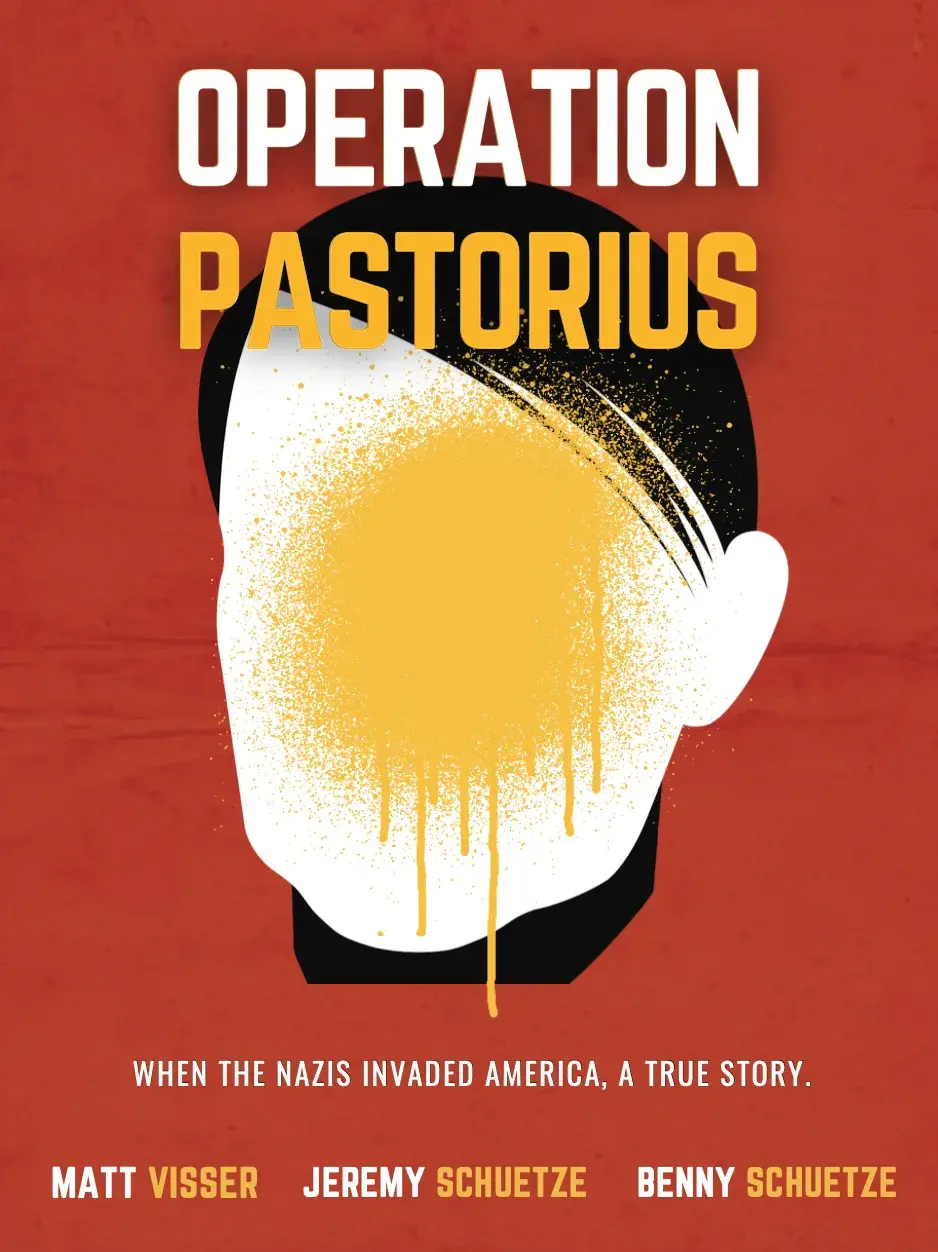
  • Poster artwork for the screenplay Operation Pastorius

    Operation Pastorius

    Matt Visser, Jeremy Schuetze, Benjamin Schuetze113 pages

    When the Nazis invaded America. A true story.

    Read the full pitch

    Short synopsis

    In the early morning of June 12th, 1942, a Nazi submarine landed on a beach in The Hamptons. It carried a specially trained group of spies whose orders were to carry out acts of terror and sabotage within the United States. Luckily, they were fucking idiots.

    Comps (comparisons)

    Death of Stalin, 4 Lions, Jojo Rabbit.

    The hook

    What makes the script unique is its tone. Operation Pastorius lives in the space of The Death of Stalin and Jojo Rabbit: the comedy comes from vanity, panic, and incompetence, while the stakes stay deadly real. The threat is genuine, and the men carrying it out are hopelessly, recognizably human. Some are terribly misguided, some are truly evil, and some are simply trying to escape. It is also a story almost no one has heard, which is rare for World War II: a true invasion of the United States that audiences get to discover for the first time.

    It needs to be told now because fascism no longer feels like a period piece. This story is a reminder that these atrocities aren’t as far behind us as we’d hoped.

    Scale / budget

    Mid Tier Feature.

  • Integrity Brotherhood

    Tim Nyquist120 pages

    At a remote Christian men’s retreat in an abandoned woodland compound, an insecure young man in the midst of a faith crisis is forced to confront the charismatic cult leader from his past; an encounter that turns a weekend of “brotherhood” into a harrowing fight for his soul and survival.

    Read the full pitch

    Short synopsis

    Noah, an insecure ex-vangelical facing a faith crisis, seeks permission to marry his childhood sweetheart, Anna. Instead, her father sends him to a secretive Christian men's retreat at an abandoned compound led by Paul, a shadowy figure from Noah's past. At the retreat Noah befriends Alex, another young man with a mysterious and traumatic past, and together they are manipulated, abused, and pushed to their limits. Uncovering a seedy underbelly of Christian Nationalism and toxic masculinity, they must fight to escape and save their loved ones. When the retreat erupts into a life threatening chaos of flames, gunfire, and swordplay, they narrowly escape, returning home forever changed. Paul's social engineering of toxic masculinity ultimately becomes his undoing as his organization quite literally comes crashing down around him. In the aftermath, Noah and Alex discover the threat may not yet be over, but have found their voices and the strength within to stand up and fight back.

    Comps (comparisons)

    Genre Fans (Psychological Drama & Thrillers): Audiences ages 18–45 drawn to tense, high-stakes stories centered on survival, psychological control, and trauma. This group responds to films such as Midsommar, The Wicker Man, Opus, The Sacrament, Apostle, and Martha Marcy May Marlene.

    Cultural & Social Commentary Viewers: Individuals interested in political and social deconstruction. This group actively seeks out media that examines real world phenomena like the alt-right pipeline, modern political radicalization, and the intersection of masculinity and high control religious groups.

    Ex-Evangelical / "Exvangelical" Communities: A highly active and rapidly growing community of individuals who have left high control religious environments. They heavily engage with, share, and support media that authentically captures the trauma, anxiety, and PTSD of religious deconstruction. Films and television such as "Starling Girl", "Yes, God, Yes", "Saved!", "Sinners", "Midnight Mass", "First Reformed", "Silence", or "The Wise Kids".

    The hook

    This script is unfortunately based on something that happened to me years ago when I was in the throes of my own religious deconstruction. I was asked to attend a secretive Christian men’s group just like the one depicted in this story and that event was the final straw that broke the camel’s back. In the fallout of the retreat, I was stalked and harassed by the men who ran the organization for speaking out against them and I lived in fear for years. I hid the truth of what had happened from everyone I knew. It destroyed me and ultimately led to the final phase of my religious deconstruction from the worldview under which I was raised.

    The story, alarmingly, feels timelier than ever. When I was first amid my research post-event, I read everything I could about cults and how they operate. I discovered groups known as Large Group Awareness Training programs (LGATs) that were startlingly similar to my own experience, down to the layout of their well-rehearsed practices, and found that many cult experts classify these groups as “high control” or “cult-like”. Groups like the one I attended could also be labeled as “theological cults” in that they base their psychological manipulation around a pre-existing, generally accepted worldwide religion. We are now living in a world highly influenced by social media, parasocial relationships with online personalities peddling misinformation and dangerous ideology, and groups that coalesce in the physical world around those ideologies. The group I attended at the time was, I discovered, an offshoot of another organization, which itself was also branched off from yet another organization, so on and so forth. That cycle has gotten progressively worse as the years have worn on. Rather than die off, the age of social media has propelled these groups into greater heights of societal control affecting the political sphere and the rights of marginalized groups of people who are already living in constant fear. Their messaging has grown more inherently political, discriminatory, and nationalistic.

    I often wondered over the years why no one was talking about men’s groups like this one because they have only continued to grow in numbers. As I researched, I found again that many men and women chose silence just like I did because they were fearful of the repercussions. Evangelical circles tend to close ranks and move toward excommunication as a tactical move to alleviate dissent. The loss of third spaces and the community that comes with it is just one of the consequences of speaking up and pushing back, with the ramifications only growing more dangerous from there. This country is more divided than ever. We are at a crossroads, fever pitch moment that I believe requires dissent; voices who are willing to speak up and tell their stories in the hopes of saving anyone who might find themselves on the brink of self-destruction.

    Scale / budget

    I think this could be produced as a micro-budget indie with room to potentially grow into a mid-tier feature.

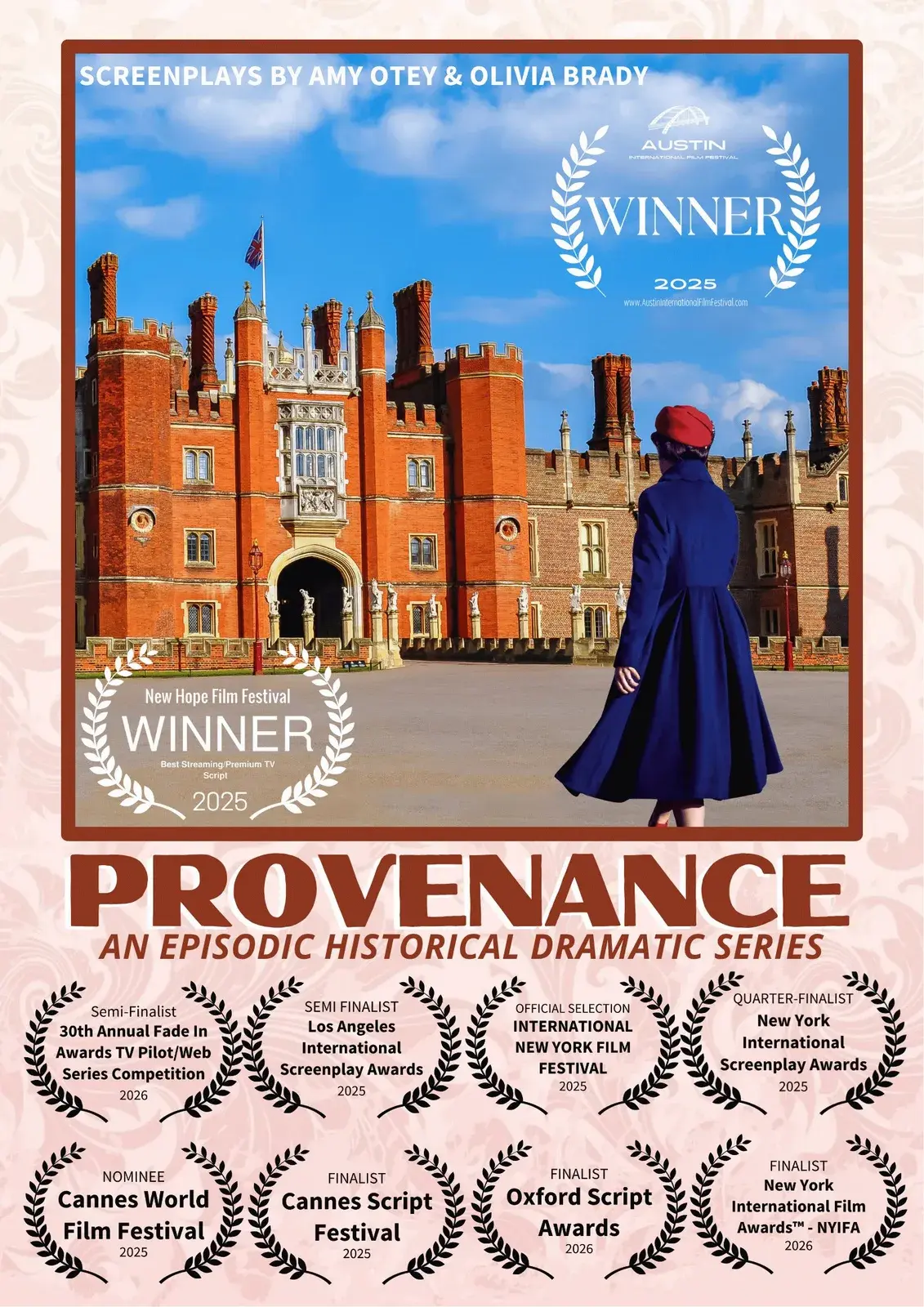
  • Poster artwork for the screenplay Provenance (Pilot/Episode 1)

    Provenance (Pilot/Episode 1)

    Amy Otey62 pages

    When her parents disappear during WWII, a clever young woman is sent to live at Hampton Court Palace, where she must transform her skills to help protect her country from secrets, sabotage, and espionage.

    Read the full pitch

    Short synopsis

    PROVENANCE is the story of a young woman's struggle to choose her best future in WWII England.

    The morning of February 25, 1944, British-Chinese student, Hannah Shore, learns her parents are missing in India. Immediately, she is compelled to leave the safety and innocence of her boarding school, and travel to Hampton Court Palace to live with her guardian. Hannah and her widowed great-aunt Lina Shore, an American expatriate, are just getting acquainted when sirens warn of an air raid. For the first time, residents and staff shelter in the undercroft with military brass, several soldiers, and a doctor from the nearby Supreme Headquarters for the Allied Expeditionary Force (SHAEF) command post in Bushy Park on the palace grounds.

    Throughout the night, the palace is bombed repeatedly. Under these circumstances, Lina introduces Hannah to her fellow residents—people who will shape Hannah’s future. Lady Manning’s eldest daughter, Rowena, becomes Hannah's fast friend. Princess Sophia sees Hannah’s potential. Birdy (Lord Birdwood) identifies her as fresh blood for his ongoing covert operations. And a handsome American pilot, Manhattan, falls in love with Hannah at first sight. When Fredrick, a member of the fire brigade, is gravely injured in a bomb blast, Princess Sophia recruits Hannah to assist the doctor. It’s not even midnight and Hannah is tested to her breaking point.

    In the series (four seasons of eight episodes each), Hannah’s journey continues through May 1945, with Lina as her touchstone. Hannah ultimately learns the truth about her parents, discovers her provenance, and comes into her own power as a young woman.

    Comps (comparisons)

    PROVENANCE lands at the lucrative intersection of two highly successful TV sub-genres: Royal Period Drama (The Crown, Downton Abbey) and WWII Home Front Narrative (World on Fire, The Bletchley Circle).

    The hook

    No one else can tell this story with the intimacy it deserves as it is inspired by the life story of our great-aunt Lina Shore, who lived at Hampton Court Palace, and was one of the few Americans ever to have received a royally-bestowed grace-and-favour apartment. Lina was a Philadelphia socialite who married a British officer of the Indian Army, Brigadier Offley Shore, and lived out her widow’s life at the palace between 1938-1957.

    PROVENANCE offers international appeal, the glory of discovering one's lineage, and a woman's view of navigating love and espionage amidst the horrors of World War II.

    Period series have grown from 8.1% in 2022 to command 10.5% of all scripted television premieres as of 2025, proving that global buyers are actively seeking premium historical IP that combines domestic intimacy with high-stakes international conflict.

    With thoughtful collaborations, the marketability and profitability of PROVENANCE continues well beyond production and release.

    Scale / budget

    The production of PROVENANCE could either be a mid-tier feature OR a large studio tentpole depending upon investment interest, tax incentives, and use of chroma key technology. The budget would be well spent on attracting several high profile actors to participate i.e., Helena Bonham Carter (yes, she IS related to the Shore family) as Lina, Timothy Dalton as Birdy, and Meera Syal as Princess Sophia. The role of Hannah would be an excellent vehicle for an up-and-coming actress of British-Chinese descent.

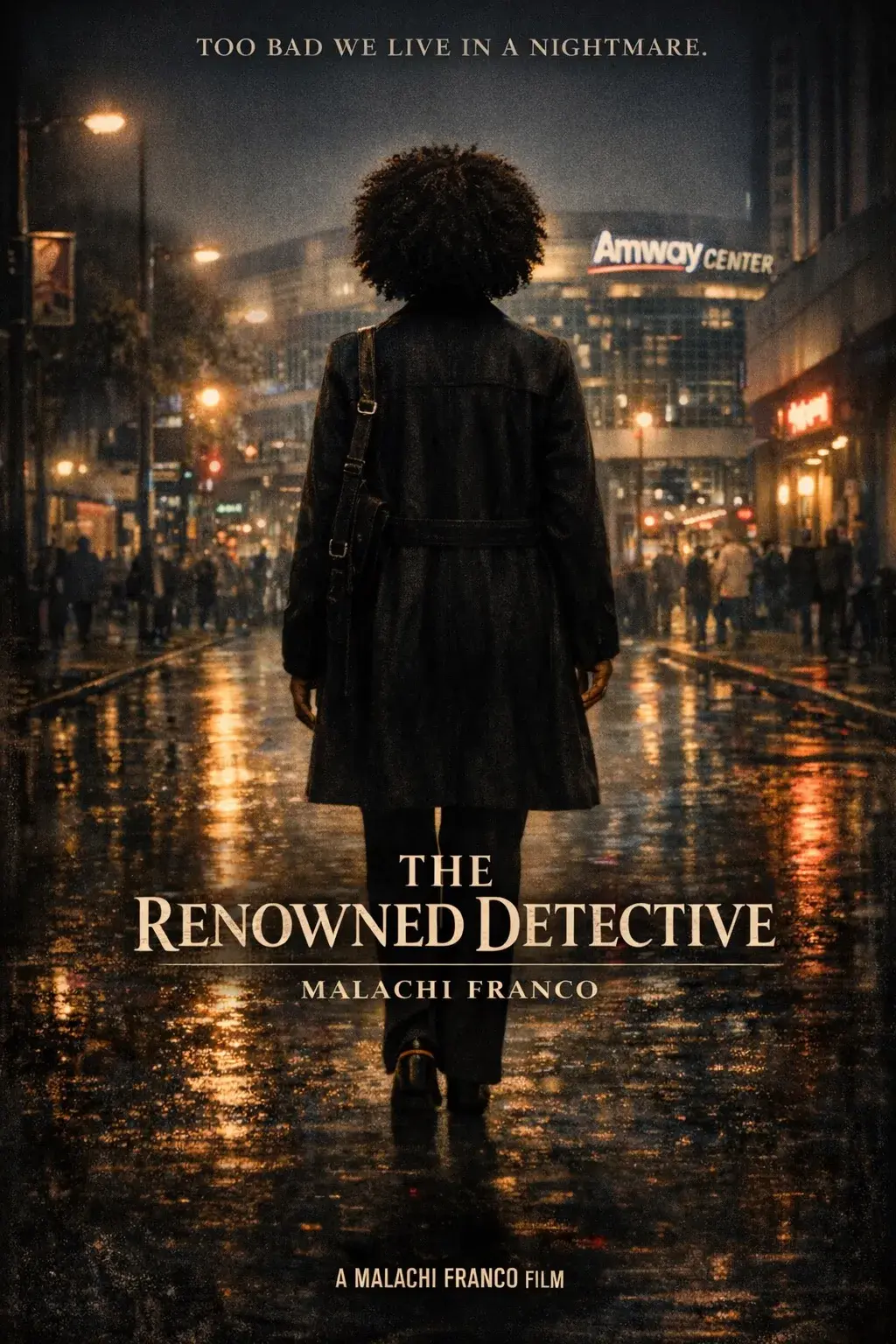
  • Poster artwork for the screenplay The Renowned Detective

    The Renowned Detective

    Malachi Franco58 pages

    When a string of staged false arrests uncovers a decade-long pattern of systemic evidence manipulation, a hyper-intelligent Black female detective must weaponize her operational analytical radar against her own corrupt Orlando precinct before the machine erases her family lineage.

    Read the full pitch

    Short synopsis

    In Downtown Orlando, Detective Olivia Dare walks a razor’s edge between the clinical machinery of the precinct bullpen and a neighborhood drowning in systemic survival. When a string of routine street murders and a staged false arrest reveal a lethal municipal countdown, Olivia must weaponize her operational analytical radar to decode the pattern. Teaming with a willfully blind rookie partner, her investigation leads straight from the convenience store aisles to a packed arena baseline, unmasking a web of corruption woven into the city’s very foundations. But as the clock hits zero, Olivia faces the ultimate institutional horror—an engineered trap designed to co-opt her memory before it claims everyone she loves.

    Comps (comparisons)

    The Godfather meets Chinatown, written with the relentless visual economy of a modern independent auteur.

    The hook

    The protagonist of The Renowned Detective, Detective Olivia Dare, functions as the living, fully armored visual resurrection of my biological mother, Olivia Renee Diggs, who was taken from me in a brutal murder at just 32 years old. Our family never held a funeral, we never got to say goodbye, and everyone simply brushed it over. This work is a movement to ensure her culture, her voice, and her endurance are permanently preserved and safe from erasure. This project is far more than a standalone feature; it operates as the modern visual anchor to an overarching 100-year cross-generational franchise matrix that loops seamlessly into its historical prequel, Jonestown. Together, these scripts form a flawless structural mirror tracking a century of institutional containment, capitalism, and systemic extraction across the landscape of Orlando and Central Florida. Stories like this matter because they preserve culture and voice when the machine tries to impose silence. It is a movement.

    Scale / budget

    Micro-budget indie feature. Highly cost affective and engineered with precise line economy for maximum independent production velocity.

  • Poster artwork for the screenplay Never Forget

    Never Forget

    Kevin Chesley99 pages

    A true story of World War II fought on two fronts, the boots on the ground of Michael Caprio and “The Rag Tag Circus” of the Army’s 83rd – told through his letters found decades later… as Caprio’s son uses them to aide his mother’s fight against dementia.

    Read the full pitch

    Short synopsis

    Based on the book WWII: The Letters That Brought Him Home, this is a true story of WWII fought on two fronts, the boots on the ground of Michael Caprio and the Army's 83rd... told through his letters found decades later by Caprio's son, Mike (the book's author) as he used them to help his mother through her fight with dementia.

    The 83rd fought from Normandy to the Elbe, liberating concentration camps and cleverly stealing every German vehicle they could find – from tanks to fire trucks and cement mixers – as they became “The Rag Tag Circus” thundering toward Berlin.

    Decades later, that same heroism and courage would be mirrored in Michael’s son, as he read the war letters to his ailing mother. When Vera’s dementia makes her believe the letters are current – that her husband is still over there – it’s up to Mike to not only help her struggle with reality… but also to find his own peace and connection with a mother he can’t bear to let go. True to real life, Mike will also find solace in a new love of his life – as well as a renewed passion to keep the memory of his father’s heroism alive. His search for meaning reflects on his father’s wartime shellshock. The tale of two men fighting through hell, decades apart, in a way that would make each other proud.

    Comps (comparisons)

    The epic war action of Saving Private Ryan weaved with a mother/son drama by way of Still Alice.

    The hook

    Never Forget is the first story of its kind that echoes the horrors of war off of a soldier's family decades later in a quest for healing. The drama, fear, and courage a man shows in WWII gives inspiration to both his wife and son long after his death - fighting a modern day battle against dementia that audiences of 2026 know so well and yearn for answers to. This is a story about a very current crisis finding peace through the heroism of our greatest generation.

    Scale / budget

    The modern half of Never Forget can be shot with a very low budget, with the war elements needing the same kind of ingenuity that made recent WWII films like Pressure, Darkest Hour, and The Six Triple Eight affordable while still accurate in its battle scenes and time period.

  • Fifty Point One

    Steven Eisenberg98 pages

    An oncologist adored by his dying patients but a stranger to his own family risks his marriage and his savings on a cancer clinic where time is the treatment — then has to survive his own failing heart to bring that time home.

    Read the full pitch

    Short synopsis

    Dr. Steven Eisenberg is the oncologist every dying patient wants — and the husband and father no one at home ever sees. A childhood bike crash left him briefly unable to speak but able to sing, and he's built a career on that gift: writing songs with his cancer patients inside a corporate mega-practice that allots nine minutes a person. His partner, Gary, says the math is simple — efficiency saves more lives. Steven's body disagrees: a bleeding gut, migraines, a cardiac warning he buries in a drawer.

    When Gary puts him on a performance-improvement plan for caring slowly, Steven quits. With his wife Julie as reluctant general, they sell the house and open a clinic 50.1 miles away — a tenth of a mile past his non-compete — with guitars in the corners and no clock on the wall. It works. Then Gary sues, and the heart he never had time for detonates.

    He survives to find his waiting room full of patients singing his song back to him. He wins the lawsuit; the argument, he admits, is another matter. What's left is harder than medicine: coming home. He keeps one chair forever empty for the patient he failed, sits with a dying friend through one last ordinary morning, and ends on a beach with his family, a guitar, and a mechanical heart valve keeping time. He is still here.

    Comps (comparisons)

    It's CODA meets The Big Sick, set inside the world of The Pitt — the musical heart and family stakes of CODA, the true-story illness-and-comedy of The Big Sick, and the grounded, unsentimental medicine of The Pitt.

    The hook

    The writer is "the singing oncologist" — a real doctor who has co-written more than 150 songs with his cancer patients and built one of California's largest oncology practices on that idea. So the chemo rooms in this script are the real ones: funnier, stranger, and more alive than films usually allow. The antagonist isn't a villain; he's the math, and he isn't entirely wrong. And the mechanical heart valve the hero wakes up with becomes the film's metronome, keeping time under the final song.

    Why now: American medicine is in a burnout crisis. Physicians are leaving in record numbers, private equity is buying up practices, and the fifteen-minute appointment is the norm. Everyone has sat in that room. This is the story of a doctor who walked out of it — and what it cost him — told with music and jokes instead of a lecture.

    Scale / budget

    Mid-tier indie, roughly $5–10M. Contained locations — a clinic, a house, a hospital, a beach — a lead role actors will fight over, an ensemble of showcase supporting parts, and a built-in original soundtrack. No VFX beyond a few moments of light magical realism. A specialty-label film in the CODA / The Big Sick mold, built to premiere at Sundance or Toronto, with a true-story author who has a national media platform (TODAY, GMA, People) to support release.

  • WALTER KARP (AKA Walter's Dilemma)

    Deborah Packer100 pages

    An emotionally challenged rocket engineer struggles to pick up the pieces and redefine his miserable life after losing his precious job to cutbacks, his less than precious wife to a younger man and his more than precious dog...to his wife.

    Read the full pitch

    Short synopsis

    WALTER KARP'S life is unraveling. His wife, SYLVIA, feeling an overwhelming void in their marriage, divorces him and starts an affair with a younger man, but far worse - insists on keeping his beloved dog, SHELDON. Then, his twenty-year hallowed position as a rocket engineer is terminated without warning. Begrudgingly, he allows his truculent, overbearing psychiatrist turned stock-broker brother, SAM, to set him up with a shrink and an employment counselor who talk him into a 'job from hell' (of which he is horribly unsuited) soliciting for money in a fundraising firm. There he meets REBECCA, an insecure divorcee with an intractable teenage son. After some very awkward dates, she begins to win his trust and love...until Sylvia calls, traumatized by her broken love affair, suicidal and pregnant, beckons him back with a healthy dose of drama, tears, and the prospect of spending time with his beloved Sheldon. Fifteen years of marriage is over, but when does the responsibility end? This impulsive but knowingly irrational gesture triggers a downward spiral, turning him into the angry, uncaring jerk he despises in his brother. One day after he walks past a prostrate man near his apartment, thinking him drunk, he learns the man had been mugged and left to die. Mortified by his own lack of humanity, he finally gets a chance to redeem himself. Through the very fundraising job he despises, an innocent phone call to a despondent older woman sets in motion an incident which shocks even him but finally gives him the strength to confront Sylvia and attempt to heal what's left of his fractured relationship with Rebecca.

    Comps (comparisons)

    "Houston, we have a problem". This is a dark romantic dramady. As a fan of the screwball comedies of Billy Wilder, Preston Sturges, Norman Krasna and Frank Capra, I yearn to write intelligent dialogue and character driven stories, but I am at a loss to 'compare' to any film. I based part of my story on my experience working for the DNC raising money for Clinton's two Presidential campaigns in a fundraising firm, took copious notes, grateful for the amount of comedy material those unwitting, often crazy fundraisers offered me. Also, as a classically trained actor with years of studying the brilliant dialogue of major playwrights, my brain can't go to comparisons. I have no right. I just make attempts and leave it to readers to judge.

    The hook

    As mentioned, my own experience fundraising for Clinton's two campaigns in the early 90's gave me an abundance of real material, but considering the moral numbness of our country right now and based on the horror of the repellant Trump and his willing sycophants who have gone rogue, I think comic relief has become a necessity. My hope is that this cynically, sometimes dark story, with comic and dramatic overtones, might in some way help soothe our daily trauma. A film about a man losing, then finding his moral compass just might resonate right now...but what do I know!

    Scale / budget

    This film is an indie feature and I think the budget, given the locations, may be mid-tier or micro- if a million is considered small.

  • Go Home

    Sohrab Fracis112 pages

    The U.S. backlash to the Iran hostage crisis blurs the lines for Viraf, a Parsi Indian foreign student on a transnational quest for home, between his peace-loving Deadhead neighbors and violent, xenophobic strangers.

    Read the full pitch

    Short synopsis

    In the “leaving home” scene, young Viraf sets out (as did I) from Bombay’s neo-gothic Victoria Terminus for the Indian Institute of Technology, a stepping-stone for studies abroad. His father Aspi asserts Viraf’s right to space on board, as migrant families must, against a contentious mainstream-Indian passenger. The journey story is now in motion. The adventurous Viraf applies for admission to U.S. colleges just as the 1979-1981 Iran hostage crisis is settled. His Parsi/Zoroastrian family watches on TV the return of American hostages. A man waves a sign: DEPORT ALL IRANIANS. GET THE HELL OUT OF MY COUNTRY. At 22, Viraf is a busy research assistant at University of Delaware. Americans angered by the Iran hostage crisis, which was 9/11 before 9/11 and the 2026 war with Iran, yell at him in campus town streets: “Go home, you fuckin’ Iranian!” But now where is home? And what makes it home? Viraf wants to find his “perfect place.”

    His guitarist and artist neighbors, Doug and Ali, introduce him to the exciting world of American rock bands, bars, and groupies. They embody the counterculture, love-and-peace, sex-drugs-and-rock-’n-roll pull of the early-’80s and take him on an acid trip to a dazzling New World. Yet he can’t shake the powerful tug of the Old World, personified by his darkly beautiful Indian ex-girlfriend, Maya, who appears at the heart of his hallucination. Ali is flirtatious with Viraf, who is drawn to her. But she’s hurt when Doug is openly not monogamous with her. Torn between the two women who represent East and West, as he searches for his “place in the world,” Viraf needs to choose.

    His black fellow teaching assistant, Will, warns Viraf that his used Pinto is dangerous. Road-rage strangers in a Bronco, contemporary cowboys, chase the Indian Viraf’s flammable Pinto and assault him. Angry and disenchanted with America, he tells no one, bottling it all up. His reactive paranoia and PTSD alienate him from his well-meaning American friends. Despite Ali’s peace-keeping efforts, he has a shouting match with Doug. When the band’s drummer, Bernie, offers up a “peace pipe,” reversing the Cowboys & Indians dynamic, Viraf says, “Fuck you and your peace pipe.” The antagonistic force of xenophobia is prevailing against the unifying force of common humanity. Instead of a “perfect place,” he’s in a nightmare.

    He visits his ailing grandma, Mamaiji, in his motherland and reignites the passion with Maya. His father expects him to join his construction business, but now Viraf empathizes with the exploited “lower caste” workers, even when a workers’ protest march endangers him. Where is that “perfect place”? It’s dawning on him that there’s no such thing. On his return to the States, disturbing news of Mamaiji’s death is followed by a showdown with his department chairman. He backs the authoritarian chairman down, with angry disregard for his power. But Viraf must get his thesis done before his assistantship expires and he has to leave the U.S.

    Viraf and Ali are increasingly attracted and go to a Grateful Dead show. The Deadheads offer a fun sense of community and home on the road with Ali. Confronted by an aggressive “redneck,” however, this time Viraf triumphs, walking a fine line between Gandhian nonviolence and American bravado. But Ali is freaked out by this. She reunites with Doug. Driving back through a blinding blizzard in a symbolically white landscape, Viraf survives and stands tall on the historic Delaware Memorial Bridge between two states. He has transcended all his difficulties, as resilient immigrants have done throughout American history.

    Comps (comparisons)

    THE MAN WHO KNEW INFINITY (Dev Patel, Jeremy Irons, Devika Bhise) meets ALMOST FAMOUS (Patrick Fugit, Kate Hudson, Billy Crudup).

    The hook

    GO HOME repurposes the xenophobic insult, on behalf of all outsiders, as an international quest for home. Home is the elusive holy grail, in this gritty-realism story with a bow to classic genres. In our xenophobic climate featuring mass deportations of brown-skinned people and a president who told U.S. congresswomen of color, including those born here, to “go back” to the “crime-infested countries from which they came,” GO HOME is hugely topical. Set in the turbulent wake of the Iran hostage crisis, which was 9/11 before 9/11 and the 2026 war with Iran, there are few more relevant stories to be told.

    Scale / budget

    In terms of budget, GO HOME could probably be a mid-tier feature. But it does have the wide scope and scale to be a large studio tentpole if a studio is interested.

  • Poster artwork for the screenplay Oceans Wild

    Oceans Wild

    Norm Hunter103 pages

    When a genius ocean scientist's solitary existence of protecting endangered marine life is turned upside down by the arrival of a fiercely independent teen daughter he never knew about, their fragile bond is put to the test when her reckless behavior threatens both her life and his career.

    Read the full pitch

    Short synopsis

    Brilliant ocean scientist Ryan Stevens has devoted his life to saving the oceans above all else – no hobbies, no friendships, not even a love life. With meals an afterthought and his house in Puerto Rico overflowing with ocean research gear, Ryan is determined to win the UN’s Ocean Conservation Prize and gain a global voice that will make his feeble attempts to awaken the public—performed in a ridiculous polar-bear suit—unnecessary. Then sixteen-year-old Tally Winslow crashes into his carefully controlled world, revealing that she is his daughter. Having lost her mother, she is desperately searching for a father. Reluctant to become a parent, Ryan agrees to let Tally stay through the summer, only to discover that the fearless, funny, ocean-obsessed teenager may be the missing element in both his life and his fight for the planet. When Tally joins the lab and turns his absurd polar-bear protests into viral social media events, Ryan begins to understand that saving the ocean—and being a father—may not be separate missions. Their fragile new family is tested when Ryan’s research brings him into the orbit of Nijat Khan, whose Malaysian “turtle conservation” operation conceals a global poaching network. Working with Coast Guard Commander Lisa Gonzalez - Mia’s mother, and a woman who sees the good beneath Ryan’s obsessive exterior - Ryan tries to uncover the truth. But when Tally and Mia discover Nijat’s secret, they are kidnapped and taken aboard his vessel. Ryan and Lisa launch a desperate Coast Guard rescue that culminates in a high-stakes confrontation at sea. Ryan nearly drowns trying to save Tally, but they both survive and he finally chooses the people he loves over the single-minded pursuit that has defined him.

    Comps (comparisons)

    ERIN BROCKOVICH meets TRUE GRIT

    The hook

    Climate change is the challenge of our times and a story like OCEANS WILD, which puts entertainment first and foremost, is the way into the hearts and minds of audiences around the world. There are no doom-and-gloom scenarios or science lectures, just a human story about a flawed individual trying to protect the amazing world of marine life that gave him refuge as a child. It’s funny, dramatic, romantic and adventurous. Audiences from all walks of life appreciate the fact that no amount of PhD's can equal the education one gets by suddenly becoming the parent of a rebellious 16-year-old.

    Scale / budget

    Mid-tier feature. A large production company would make this for $25M and a studio for $45M. My prior film was a streaming release via The Disney Channel and MGM.

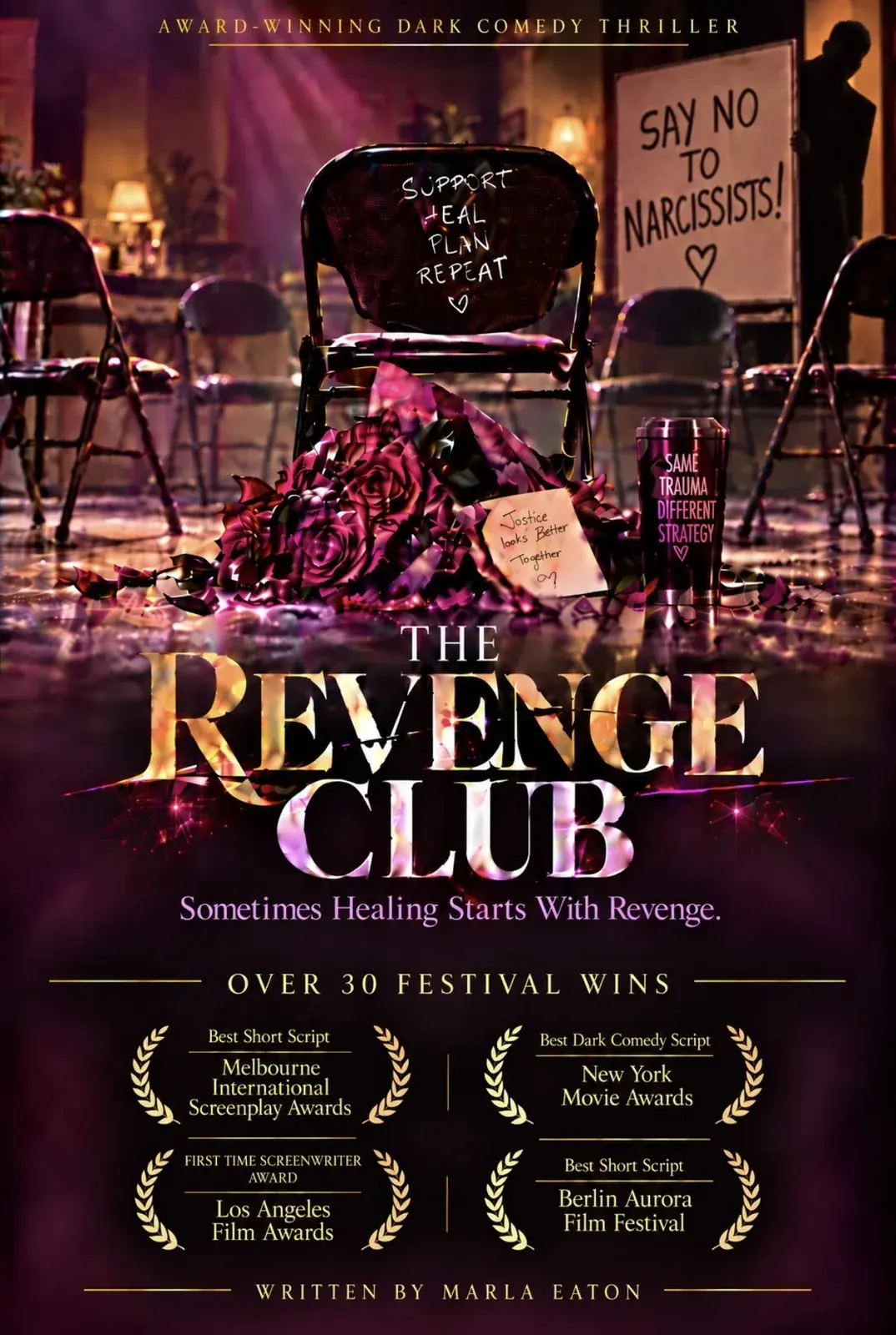
  • Poster artwork for the screenplay The Revenge Club

    The Revenge Club

    Marla Eaton17 pages

    A quirky support group for survivors of narcissists turns into a secret revenge club—but when one mission goes wrong, their quest for justice takes a dangerously unexpected turn.

    Read the full pitch

    Short synopsis

    Makayla Price starts a support group for survivors of narcissistic relationships, hoping to create a safe place to heal. But as stories of manipulation, humiliation, and betrayal pile up, the members begin to wonder whether talking is enough.

    Everything changes when Amber Lane joins and discovers that she and Makayla were both involved with the same man. Their shared betrayal helps turn the support group into a secret revenge club.

    Soon, the members are helping one another carry out increasingly bold acts of payback against the narcissists who hurt them. The schemes are darkly funny, cathartic, and empowering—until they turn their attention to Keith. Their campaign against him begins dismantling the carefully controlled life he has built, sending him into a public spiral.

    After Keith disappears, police begin investigating his suspected murder, and months later Makayla and Amber are arrested as suspects. But the truth is even more dangerous: Keith is alive—and holding Steven, one of the club members, captive.

    With Keith still out there and their secret beginning to unravel, the revenge that helped them reclaim their power may now put them all in danger.

    Comps (comparisons)

    It’s “Bad Sisters” meets “Dead to Me” with the darkly comic revenge edge of “Promising Young Woman.”

    The hook

    The Revenge Club begins where most stories about emotional abuse end: after the survivor leaves. Instead of focusing on escape, it follows a group of mostly middle-aged survivors who turn healing into action, using increasingly outrageous revenge schemes to reclaim their power. The series combines dark comedy, emotional truth, friendship, and a serialized thriller mystery, while centering women over forty as funny, flawed, resourceful leads rather than side characters. At a time when gaslighting, coercive control, and narcissistic abuse are part of the cultural conversation, the series asks what happens when people who have spent years being manipulated decide they are done playing by the rules.

    Scale / budget

    This is a Micro-budget to low-budget indie series. The concept is designed around a contained ensemble, practical locations, and character-driven set pieces rather than expensive action or effects. That makes it highly producible while still allowing the revenge missions and thriller storyline to feel cinematic.

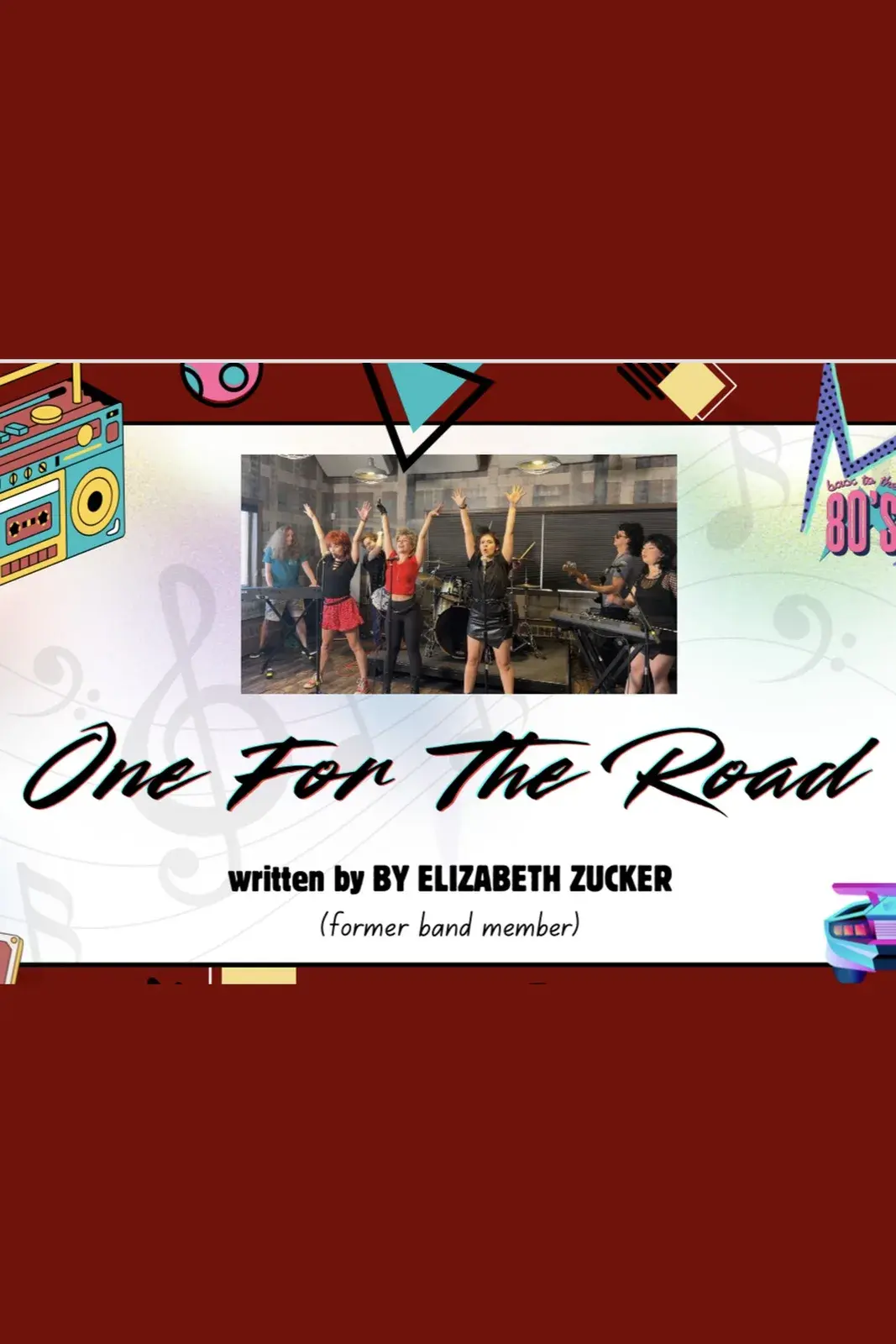
  • Poster artwork for the screenplay One for the Road

    One for the Road

    Elizabeth Fern Zucker125 pages

    While on the road with her pop-band, a developing musician has her heart broken and is forced to choose between success and self preservation as friendships fall apart on the way to Hollywood.

    Read the full pitch

    Short synopsis

    The story focuses on the friendship between the four main girls in the band; Roxanne & Nicki (sisters from the Bronx), Fern and Gwen. This is their story of making it in the music industry and then watching it all fall a part. Fern, a young keyboard player/singer and our protagonist , starts out hopelessly in love with her manager, Chip, only to have him break her heart in the middle of the tour when he chooses one of the other girls in the band over her. Life lessons, comedy and drama ensue all to an all original soundtrack of the 80’s. Their journey takes them from being on the road and staying in seedy hotels and filthy band houses, to flying to Hollywood to be on the number one TV show at the time - “Star-search”. Finally, they stay at a beautiful hotel on the Sunset Strip. Then, after performing on the air for their first time, they win and suddenly become America’s Sweethearts! But after an entire season of winning, they lose the big Finale show, where they would have won 100,000.$ . After that, the band eventually falls apart. The secondary characters, the boys in the band and the roadies all provide hilarious comic relief as they try to live together on the road with sex, drugs and rock and roll. While all along, the girls remain hardworking and disciplined.

    Eventually, after the breakup of the band, the two sisters go on to Broadway and the other two go on to marry and have children and careers of their own. Even though, the band breaks up on very bad terms…and they don’t speak for 30 years, the girls rekindle the friendship when they accidentally bump into each other in NYC at a cabaret bar. Years of guilt and pain melt away with tears and hugs. They have all made it and all, have it made. The boys in the band wind up playing weddings and bar mitzvahs, and after losing all his money, Chip winds up a florist. The movie’s messages are; It’s ok to make mistakes, as long as you learn from them; When friendships are real - they’ll last a lifetime and …don’t do drugs (or sleep with hookers with crabs.) The movie will be filled with original music from the original band “Jailbait” along with 80’s hits as a backdrop!

    Comps (comparisons)

    Think ALMOST FAMOUS meets THE HANGOVER

    The hook

    Music, Laughs, & Pain of an 80s pop band.

    I wrote this screenplay as a love letter to these wonderful, wacky musicians and singers I spent 3 years on the road with. We loved each other, we hated each other and whether we knew it or not, we were a family . No matter what challenges or drama we faced. We got on stage every night and always kicked butt! It was our time and it was sensational, until it wasn’t. When Michael, our manager and bass player died in 2020 from covid, I was asked by his brother to go over his house and find all the music and collect it and preserve it. That day, I wound up finding not only all our old songs we recorded from 1983-1985, but a soundtrack to my screenplay - “ONE FOR THE ROAD.”

    Scale / budget

    I see this movie as a major feature length film which would cost about 11 million to make.

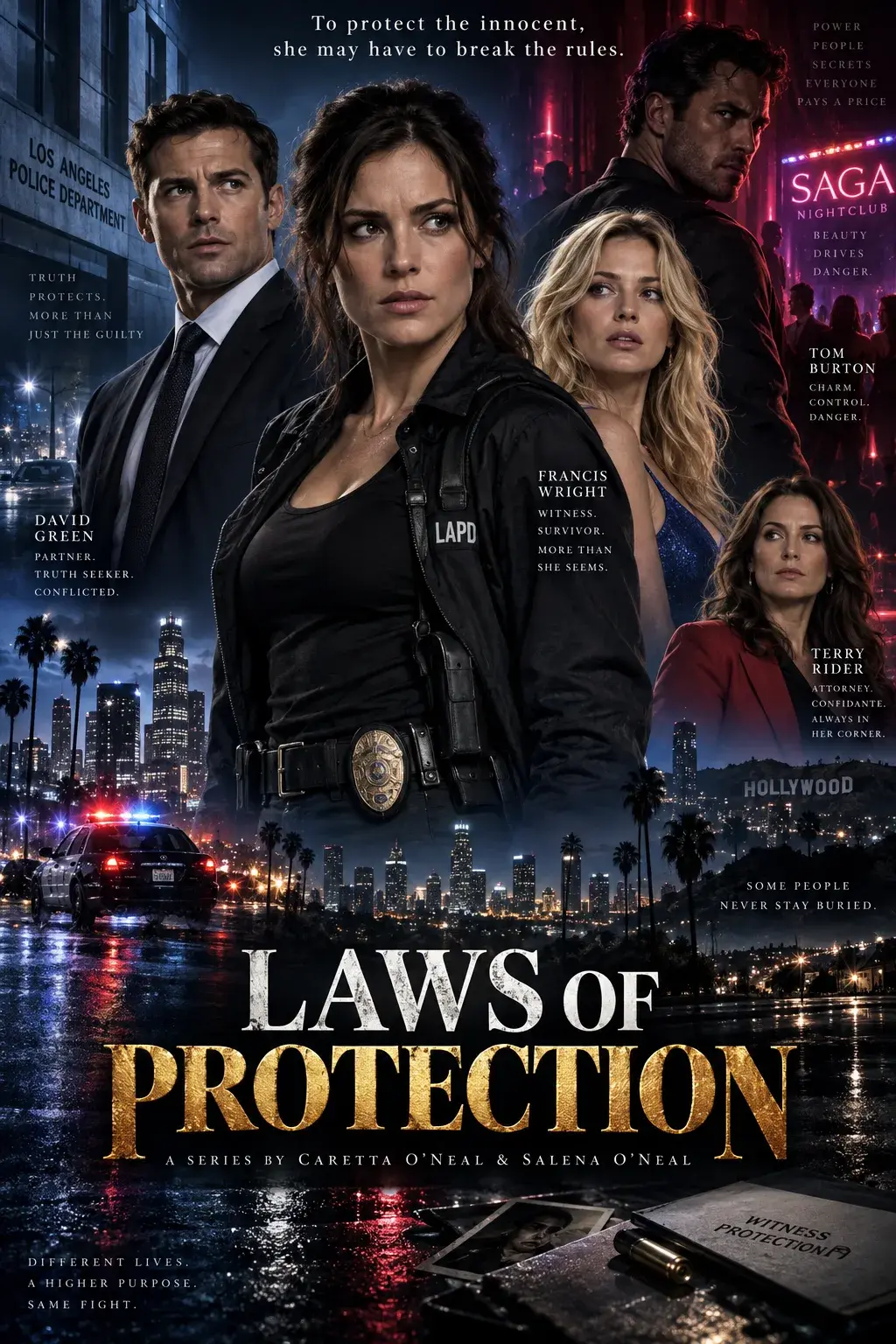
  • Poster artwork for the screenplay Laws Of Protection

    Laws Of Protection

    Caretta Elizabeth ONeal, Salena Marie ONeal56 pages

    An LAPD detective falls for the witness she should keep at arm’s length while her trusted partner secretly protects the dangerous criminal she is hunting.

    Read the full pitch

    Short synopsis

    LAPD Detective Rebecca Jones is pulled back into a financial-crimes investigation that leads directly to Saga Nightclub and its dangerous owner, Tom Burton. There she encounters Francis Wright Tom’s abused girlfriend and bookkeeper, and potentially the key witness Rebecca needs to bring him down.

    When Francis finally leaves Tom, Rebecca’s professional obligation to protect her becomes increasingly personal. Their growing attraction blurs boundaries just as Tom tightens his grip, determined to recover Francis or silence her before she can expose what she knows.

    Rebecca believes she can trust her longtime partner, Detective David Green, as the investigation closes in. What she doesn’t know is that David is secretly Tom’s brother and has been protecting him from inside the LAPD.

    By the end of the pilot, Francis has broken away from Tom, but safety remains out of reach. Rebecca’s involvement with her has put both her career and the investigation at risk, Tom is closing in, and David quietly helps his brother secure legal protection while keeping their relationship hidden. Rebecca thinks she is hunting a criminal from inside the system without realizing the betrayal is already standing beside her.

    Comps (comparisons)

    The Shield meets Big Sky with the emotional tension of Found. The combination communicates serialized police corruption, a dangerous criminal investigation, morally complicated relationships, and a deeply personal protection story.

    The hook

    What makes Laws of Protection different is that the person Rebecca trusts to help her solve the case is secretly protecting the man she is investigating. At the same time, the witness Rebecca is supposed to protect becomes the woman she is increasingly unable to keep at an emotional distance.

    That creates two ticking clocks: Rebecca is falling for Francis while unknowingly confiding in the very person helping Tom stay ahead of her.

    The series uses a grounded crime thriller to explore abuse, loyalty, corruption, trust, power, and what happens when protecting someone requires challenging the institutions and personal boundaries you once believed would keep you safe. The central question isn't simply whether Rebecca can bring Tom down. It's what protecting Francis will cost her before she discovers that the betrayal has been beside her all along.

    Scale / budget

    I would describe it as a mid-tier serialized television drama, not a micro-budget project and definitely not a tentpole. The production is grounded and achievable: Los Angeles locations, LAPD environments, Saga Nightclub, apartments, offices, courthouse spaces, vehicles, safe houses, and occasional action/suspense sequences.

    It doesn't depend on expensive VFX, enormous set pieces, exotic locations, or constant stunt work. The production value comes primarily from cast, locations, cinematography, suspense, and performance.

    Mid-tier one-hour television drama with a grounded production footprint and premium crime-thriller feel.

  • Poster artwork for the screenplay Tomber Amoureux, Encore

    Tomber Amoureux, Encore

    Gregory Proulx118 pages

    When a successful American venture capitalist and hopeless romantic relocates to Paris just as his marriage of 18 years unexpectedly unravels, he is forced to re-examine his priorities and purpose in life, while navigating the quirkiness of French culture and relationships in his quest for happiness and love.

    Read the full pitch

    Short synopsis

    This story explores the idea of the narrative of one’s life that a person constructs, and how it might evolve in the face of a ruptured marriage, intersecting the themes of identity, relationships, commitment, culture, and family.

    The plot revolves around Paul, a successful American venture capitalist and hopeless romantic, who believes he and his wife have it all. With financial freedom to go anywhere or do anything, Paul wakes up each day energized and optimistic. Yet his wife Claire is having a mid-life crisis as she approaches her 40th birthday and wants change. Couples counseling leads to a bold decision to move to Paris and “live their most authentic lives”. Paul goes ahead to Paris and a week later, Claire never shows up, ultimately asking for divorce.

    What follows is a quest for romance, love, and family in Paris, where Paul experiences the quirkiness and peculiarities of French culture, deciphering the unwritten rules and expectations of daily life. Enchanted by Paris and the French way of life, Paul learns to be a flâneur, as he and Poppy, a British colleague, develop a close friendship exploring the city together, and she secretly hopes for romance. But Paul also meets Camille, a French single-mom and her precocious 7-year-old daughter Gigi. Paul is captivated by them both, and especially Gigi’s bright, playful spirit, and a loving bond grows between the three of them as they spend more time together.

    What Paul wants most in life is to have a relationship of trust, romance, and belonging, including a family of his own. But Paul is a people-pleaser to a fault and neglects his own needs and priorities. What he needs is to stop pleasing everyone else and finally take charge of his life. Paul ultimately finds what he's looking for in Cassis, over an idyllic August vacation he spends there with Camille and Gigi at her family home.

    Comps (comparisons)

    Think 'Midnight in Paris' (2011) for its cinematography and Paris charm, meets 'Les Enfants des Autres' (2022) for its story and tone (but with the parent's gender reversed).

    The hook

    I felt it was important to tell this story from a male protagonists’ perspective, as often stories in this same vein seem to be shown from the female protagonist’s viewpoint. In writing Paul as the main character I also wanted to portray an alternative perspective of how a fully realized man might behave and think in today’s world - a society that is over-saturated with toxic masculinity, bro-maxxing, and testosterone-fueled social media rants. Paul is a flawed man for sure, but he also is a man of integrity, loyalty, kindness, decency, and authenticity. He is strong and confident but not in a flashy way, and he has emotional maturity to be self-reflective and ultimately take accountability for his own actions. I think of him as the ‘feel-good’ antidote to some of the negative relationship trends in today’s world. This not-so-subtle shift makes the story more interesting simply because there aren’t a lot of stories like this told from the male perspective.

    Scale / budget

    I see this film as a mid-tier feature, with the budget to film in 3 locations: the majority of the film takes place in Paris, and is book-ended by an opening in San Francisco and an ending in Cassis, France.

    Awards and selections

    Oxford Script Awards Autumn 2026 - Finalist

    Finalist, Best Feature Screenplay, International Indie Film & Screenplay Festival (Ardélion European Film Association), 2026

  • Hurricane Huskies

    Larry Masters80 pages

    A disabled dog leads the pack to the finish line.

    Read the full pitch

    Short synopsis

    In the frozen Alaskan wilderness, the Great Tundra Race pits the disciplined Hurricane Huskies against the ruthless Siberian Icebreakers. While the Icebreakers dominate through brute force and relentless speed, the Hurricanes rely on strategy, patience, and control to stay in the race.

    At the center is Wolf, a three-legged husky burdened by self-doubt after years of rejection from his father, Bear, the team’s respected leader.

    When a desperate rival triggers a catastrophic avalanche, both teams are pushed to their limits. In the final stretch, Bear is critically injured, forcing him to do the unthinkable, which is placing the team’s fate in Wolf’s paws.

    With everything on the line, Wolf must overcome his past and lead the team forward.

    In the end, victory is not decided by strength but by resilience, trust, and the courage to believe in oneself.

    Comps (comparisons)

    A movie where the central character defies all odds and wins. LionKing

    The hook

    A thrilling children’s adventure movie with stunning special effects. A disabled dog is forced to do an impossible task. Wolf must take control of the dog pack and lead his team to victory.

    Scale / budget

    This is a family movie, therefore the audience is the largest and most diverse group. Kids will love the exciting story, while parents can relate to the emotional stress this young dog had to endure.

  • Best (Wo)Man

    Jim Sahlsberg119 pages

    A sexually repressed man meets a witty and sexually confident woman who challenges his fear of desire, while she confronts her own fear of vulnerability.

    Read the full pitch

    Short synopsis

    Jake Hunt is terrified that any expression of his own desire makes him a predator.

    His best friend, Amy, announces her engagement to Nick, who asks Jake to be his best man. Happy for Amy, but heartbroken, Jake has a drink in The Dragon’s Hollow where he meets Kelsie, a witty and unapologetically sexual bartender. After hearing his story, she offers to secretly help with the wedding planning.

    Amy has wedding jitters stemming from her ex-fiancé, Kieran, cheating on her with a younger woman, while Jake is walked all over by his boss, who pressures him into missing Nick’s stag weekend to work overtime.

    Jake discovers the exhilarating world of Kelsie’s sexuality, forcing him to confront his fear of desire and confrontation, while Kelsie confronts her fear of vulnerability.

    Jake introduces Amy to Kelsie, but she recognises her as the woman she caught with Kieran. Jake fails to defend her when trying to avoid conflict with Amy, leaving Kelsie betrayed and heartbroken.

    At the wedding reception, Jake spots Kelsie outside and begs Amy to go out and talk to her. Kelsie reveals that Kieran was her boss who took advantage of her and had her fired for defamation when she tried to report him. Realising Jake’s role in her reconciliation with Amy, Kelsie decides to get back with Jake.

    After Amy and Nick leave, Jake and Kelsie have a private toast to “All the times we fucked up...and made it”.

    Comps (comparisons)

    The Mask: Not a genre like-for-like, but Stanley Ipkiss is a repressed man who finds his inner reservoirs of confidence, fuelled by a magic mask that externalises the man he his deep inside. Jake goes through a similar arc, except his catalyst is a woman who sees through the metaphorical mask he wears.

    Bridesmaids: A wedding centred story where the comedic tone is comparable, and Annie and Lillian’s friendship is tested when Helen enters the fold. Jake, like Lillian, is also caught between two people he holds dear who are at odds.

    The hook

    Dr Helen Fisher’s study on Singles In America found that 51% of single American men stated that #MeToo changed the way they navigate dating, while 33% said they acted more reservedly on a date. The main character, Jake, takes that caution to the extreme.

    He’s terrified that any expression of his own desire makes him predatory, then he meets Kelsie, a sexually confident woman who makes an art form out of flirtation. Their dynamic makes for good comedy as well as storytelling, and Kelsie’s sexuality, agency and fear of vulnerability are just as central to the story.

    To summarise the hooks, the story features many familiar beats of the genre, yet also explores relatable and rarely explored themes, giving it a distinct identity beyond a generic rom-com.

    Scale / budget

    While the story has large scale set pieces like a rock concert and a fancy wedding reception, I'd say it would be a mid-tier film.

  • Poster artwork for the screenplay The Dead Ringer

    The Dead Ringer

    Suzanne Lutas95 pages

    Because she bears an uncanny resemblance to the mistress of a London-based Chinese Triad boss, an illegal immigrant is trained by MI5 to infiltrate the gang and bring them down.

    Read the full pitch

    Short synopsis

    Mei Li, an illegal immigrant in London's Chinatown, works as a waitress and cares for her father, Jian, a former teacher now working as a casino croupier. They're both worried sick that Mei Li's younger sister disappeared during their smuggling out of China by the Snakehead gang.

    After Jian is killed in a gang raid, Mei Li must repay the Snakeheads or face their brothels—until MI5 agent Alex Rhys offers her British citizenship in exchange for working for MI5. After rigorous training, Mei Li becomes a covert operative and must assume the identity of Wu's mistress, a ruthless Triad boss.

    Once in Anna's shoes, she discovers the Triad is involved with the traffickers who took her sister. As Mei Li gains Wu's trust, her situation grows perilous, especially when the real Anna escapes and arrives at Wu's location.

    Although Wu is stunned by the two identical women, he senses which is the impostor. Yet he tortures them to learn who is pulling the strings. Just then, the Snakeheads gang storms in to "negotiate," breaking their secret deal with MI5 to keep Anna prisoner without demanding a ransom, so that Wu will yield to their demands after a fortnight. As a battle erupts, Mei Li convinces the woman whose identity she stole to team up with her to escape.

    Ultimately, Mei Li is granted British citizenship, but MI5 reveals that her sister is alive in Hong Kong, setting her on a new path that may be more perilous.

    Comps (comparisons)

    The Dead Ringer combines the intricate, identity-blurring tension of Infernal Affairs with the character-driven transformation of Red Sparrow

    The hook

    Two things inspired me to write that story. First, my sister spoke to a woman she mistook for me. Second, newspaper articles about the dealings and quarrels of Chinese Triad gangs -- in the very heart of London -- motivated the creation of a National Crime Agency in 2013, under which the London Metropolitan Police and their special Chinese Unit would team up with MI5 to stop the growing violence. My story begins against the backdrop of the Triads' feudal dispute and British national security concerns.

    Scale / budget

    I see a mid-tier feature.

  • Poster artwork for the screenplay Family Time

    Family Time

    Kamal Williams117 pages

    Three young girls from three generations, but one family line, must first understand each other's family connection before they can protect their family legacy.

    Read the full pitch

    Short synopsis

    A brilliant but emotionally isolated thirteen-year-old girl creates a homemade time machine to visit her eleven-year-old mother in 1990 and her fifteen-year-old daughter in 2057, forcing three generations of young women to confront race, identity, friendship and family legacy through the inherited lessons of Dr. Martin Luther King Jr. The genius stops at specific points in time to find connections to her direct genetic line, in hopes that one day they may be able to help her find a cure to a rare genetic disease that only she has, but misleads her adolescent mother and her future teenage daughter about her true intentions. Misunderstandings become face-to-face comedic interactions, but eventually have dramatic implications. To make amends and regain their trust, in the end, she uses the family history and its future, to go back to where their family legacy began and give both her mother and her daughter the emotional closure they didn’t know they needed.

    Comps (comparisons)

    Unlike any time travel movie ever made, because this is not a story about time travel, this is a story about family... A story of a girl's relationship with her mother and daughter. Of course it has the Sci-Fi comedy of "Back to the future", but it has socially aware intelligent females like "Hidden Figures", and the family drama complexity of "Everything Everywhere All At Once". And what coming-of-age story couldn't be compared to a Disney Princess movie, but this is like any 3 of them rolled into one.

    The hook

    Family Time is not a story about time travel, it's a story about family. • The story is a clash of history, science, longing and motherhood. The agony of knowing something is missing— and the relief of finding it. • Watch the joy of seeing family members as full people, not just roles. Seeing the parent/child bonds existing beyond scientific manipulation. • A sentimental jacket worn at Martin Luther King's last speech links generations across time. It's a living connection — worn, passed on, inherited, gifted. There's excitement in witnessing time travel grounded in everyday objects. • We see how the societal ills of the 60s overflow into the 90s and into the present. Martin Luther King’s words are eventually felt by the people living in 2057. A fictional scenario partially reflects the reality of the current social climate.

    Scale / budget

    This story can be told several ways, but deserves a modest budget. It is a mid-tier feature, or a limited series television show. I have an exciting vision of it as a broadway musical stage play, resembling the style of "& Juliet". (I even have the songs picked out).

  • Poster artwork for the screenplay THE BASALT THRESHOLD

    THE BASALT THRESHOLD

    Sergio Mario Illuminato109 pages

    An island that cannot be predicted. A woman who cannot afford to change. Seventy-two hours.

    Read the full pitch

    Short synopsis

    Pantelleria, 2035. For three years, the island has been the unstable node in a wider Mediterranean sector of MILEIU, Europe’s advanced predictive network. With a severe weather event approaching, the system has 72 hours to restore the sector’s reliability before its predictive protection is compromised. Leda Ishiguro, one of MILEIU’s most advanced synthetic humanoid agents, is sent to find the anomaly. But a creature who has never truly inhabited a body arrives in a place that demands incarnation. Pantelleria reaches her through wind, water, stone, hands, breath. Slowly, irreversibly, she is transformed. The mission fails. The system realigns Leda, erasing her episodic memory. Yet, on the verge of leaving the island, she turns back. At the Lake of Venus, a child is in danger again. Leda makes the same choice she no longer remembers making. MILEIU can erase the memory. It cannot erase what the body remembers.

    Comps (comparisons)

    AFTER YANG meets THE EIGHT MOUNTAINS, with the institutional pressure of THE ASSESSMENT.

    The hook

    A synthetic humanoid is sent to restore predictability to a critical Mediterranean node. Instead, Pantelleria changes the way she sees, chooses and inhabits her body, until the agent sent to correct the anomaly becomes something the system can no longer contain. THE BASALT THRESHOLD turns the familiar AI story inside out: the conflict is not between human feeling and machine intelligence, but between life’s capacity to change and systems that can protect only what they can still recognise. That question belongs to now. Predictive technologies increasingly shape how risk is anticipated, where attention is directed and who or what receives protection, while climate instability makes continuity itself harder to assume. The film asks what happens when life changes faster than the systems designed to understand and protect it, and whether protection can survive without forcing difference back into conformity.

    Scale / budget

    Mid-tier European feature. Current working budget: €2.5M, with approximately 30 shooting days, conceived as a three-country European co-production. Production-ready in Pantelleria: free secured locations; production base, accommodation and hospitality already in place; child performer identified and available; MAGICLAB ROBOTICS and DJI robotics, drones and technical support secured in-kind. Financing route: European co-production, Eurimages, national tax credits / production incentives, national production and selective funds, together with Sicilian regional funding. The final financing structure will be built with the lead producer. Additional European opportunity: Creative Europe MEDIA may offer co-development support once a qualifying cross-border producing partnership is in place, while separate MEDIA opportunities may become relevant later for audience development and circulation. Seeking a lead European producer with strong co-production and financing expertise to lead the project through packaging and production.

  • Poster artwork for the screenplay Everything I Wanted

    Everything I Wanted

    Job Michaud70 pages

    As summer break comes to an end, Alex finally gets the life he’s always dreamed of but when his newfound happiness begins to distort his reality, he must confront the terrifying possibility that getting everything he ever wanted may cost him everything he knows to be true.

    Read the full pitch

    Short synopsis

    As summer break comes to an end, Alex, a socially isolated college student, finally gets the chance to experience the life he's always dreamed of. With his best friend Sam by his side, Alex begins a new chapter filled with unexpected happiness, new friendships, and the possibility of finding love. But just as everything starts falling into place, Alex's newfound happiness takes a disturbing turn. Unexplained events and increasingly terrifying encounters begin to surround him, threatening everything he's worked so hard to gain. As the people closest to him become caught in the chaos, Alex struggles to hold on to the life he's always wanted. With his relationships under pressure and the situation growing increasingly dangerous, Alex must face the consequences of his newfound fortune and the possibility that getting everything he's ever wanted may come at a price he never expected. Everything I Wanted is a psychological horror film about loneliness, friendship, the desire for acceptance, and the terrifying consequences of getting exactly what you wish for.

    Comps (comparisons)

    Everything I Wanted is Black Swan meets Joker (2019), with the unsettling horror of Talk to Me. It transforms the promise of a perfect life into a psychological nightmare, exploring just how far someone might go to hold on to everything they've ever wanted.

    The hook

    Everything I Wanted is a psychological horror film that takes the idea of getting everything you've ever dreamed of and turns it into something terrifying. What makes it unique is the way it combines disturbing horror with a deeply personal story about loneliness, friendship, and the desire to feel loved and accepted. I want audiences to question what it truly means to have everything and whether the life you've always wanted is worth the price you might have to pay. In a world where so many people are chasing the idea of a perfect life, I believe this story is especially relevant today.

    Scale / budget

    I see Everything I Wanted as a mid-tier independent feature. I want to make a film that feels cinematic and intense while keeping the focus on the story and characters. I believe the horror can be brought to life through strong performances, atmosphere, and practical effects without needing a huge studio budget. My goal is to create something that stands out in the psychological horror genre and reaches a wide audience.

  • A Reasonable Person

    Irvon Clear70 pages

    This is an experience demonstrating the purpose of art. "What is Art?"

    Read the full pitch

    Short synopsis

    Imagine your neighbor places a nude classical statue of a woman in his front yard. It's a lawn ornament. Then paint it anatomically correct with a commercial artist's air brush. It becomes an attraction for sexually curious strangers. What happens to the neighborhood? There is a conflict that ends up in a civil court where a search begins for the judgment of a reasonable person. The audience is addressed as the jury. This is an experience that will display the talent of the director and the cast of actors.

    Comps (comparisons)

    This will be a unique film that will generate the kind of interest that resulted in the traffic jams on Sunset Boulevard in Beverly Hills when an Arabian Sheik had classically posed nude statues with painted genital areas placed on the front veranda of his mansion. They were visible from Sunset Boulevard.

    The hook

    The audience is addressed as the jury. They become part of the experience of discovery and judgment.

    Scale / budget

    This is a micro-budget indie. There is only one scene...a civil courtroom.

  • Gamed the System

    Lennie Graves7 pages

    The slick Accused takes on both the courts and the Grim Reaper to avoid paying his debt to society and the afterlife.

    Read the full pitch

    Short synopsis

    It’s looking bad for a slick, cocky, ambulance chasing lawyer, on trial for murder. He dismisses his lawyer to defend himself, and wins. After gaming the system, the Grim Reaper visits him at home to pay his penance for being a serial killer. It becomes a battle of wits and again the accused wins. Over confident in his superior skill to outwit others, he sleeps well that night. But wakes to find that the Grim Reaper has gamed the system and commits him to burn in Hell for all eternity.

    Comps (comparisons)

    Locked meets Send Help

    The hook

    Gamed the System flips the perspective of the Grim Reaper to actually defending human life in opposition to taking it.

    Scale / budget

    This is a micro-budget, contained indie script.

  • Poster artwork for the screenplay The Sapphire King

    The Sapphire King

    Russell A Reball109 pages

    In a fractured post-civil-war America, a fugitive enhanced soldier is forced to work with the damaged military company that captured him after they become trapped in a dead-zone town protected by a weaponized mining machine, a disturbed young woman, and a population that has mistaken survival for innocence. Sci-fi thriller with fairy-tale horror undertones.

    Read the full pitch

    Short synopsis

    In fractured and violent post-Second Civil War America, Hollister Duncan, the outcast son of a genetically enhanced Gunlord soldier, has long known that life as a monster was never going to be easy. Now, framed for treason and sentenced to death, he is offered a second chance by the arrogant Captain Radigan of the United Federal Armed Forces: enable the summoning of reinforcements by restoring the power to a damaged radio tower in the nearby, and likely hostile, town of Oliveri, or meet a grisly death in the crushing claws of the militarized mechanical drone that has just gruesomely decimated Radigan’s platoon. Hollis agrees, unaware that the two-faced Radigan is planning to use Hollis—as well as other prisoners and two government platoons—to trap and destroy the drone and annihilate those he believes responsible for dispatching it: the people of Oliveri. Expecting danger, Hollis enters the formerly idyllic town only to find that its few remaining inhabitants, the Orphans, are deranged and deluded mental patients who were abandoned during the early years of the War, perhaps intentionally, by the town’s fleeing citizens. Thus discarded, they have submitted to the erratic leadership of the self-proclaimed Princess Talia, a teenage girl whose sole objective is to protect the town’s devoted robot sentinels—he of the single blue-eye, the Sapphire King, and a second drone with an eye of red, the Ruby Queen. Hollis learns that Talia and Talia alone is able to communicate with the drones, and that it was she who ordered the King to destroy the radio tower. She is the puppet master. She needs them, as they need her. As the military closes in, with Radigan recklessly sacrificing soldiers’ lives to fuel his mad, Ahab-like pursuit of the King, Hollis is unable to convince Talia that she and the other Orphans must flee, with or without their King and Queen, and the two part ways. On the outskirts of town, a small squadron tracks down and atomizes the Ruby Queen, igniting within the King a human-like hunger for revenge that is only sated when he ultimately foils Radigan’s plan and stares with unblinking hatred into the duplicitous captain’s dying eyes. Exiting Oliveri, Hollis encounters the battered hulk of the Sapphire King returning home to his princess. The monsters exchange a brief, wordless acknowledgment—a weighty silence that seems to both recognize their shared suffering and convey a message of hope for their broken world.

    Comps (comparisons)

    The script’s thematic exploration of engineered warfare and unchecked technological advancements lends meaningful market positioning similarities to successful properties such as: Halo, The Expanse, Edge of Tomorrow, The Hunger Games, Pacific Rim, District 9, Love Death and Robots and War Machine. Authentic military references and tactics would appeal to a demanding fanbase as well. Has franchise potential.

    The hook

    The screenplay establishes a compelling central mystery that unfolds with genuine suspense—the true nature of Oliveri and its inhabitants is revealed in layers that keep the audience guessing. The relationship between Talia and the Sapphire King operates on multiple levels: what initially appears to be a fairy-tale bond between a girl and her protector gradually reveals itself as something far more disturbing—a weaponized codependency born from trauma. This subversion of the "beauty and the beast" archetype gives the story thematic weight. The Sapphire King itself is a remarkably well-conceived antagonist/character. Its origin as a Chinese mining robot reprogrammed for war, now operating without purpose in a dead zone, creates genuine pathos. The detail that its body-stacking behavior is simply a mining subroutine—piling rocks for sifting—is a brilliant piece of world-building that recontextualizes horror as mechanical innocence. The moment where the King catches Hollis after his fall, then later allows him to pass through the tunnel, suggests an internal logic and even moral reasoning developing within the machine, which elevates it beyond a simple monster. Hollis functions effectively as a protagonist caught between opposing forces—Radigan's cynical manipulation and Talia's delusional control. His Gunlord abilities are deployed sparingly enough to maintain tension; he's enhanced but not invincible, which keeps stakes alive. The scene where he destroys the tracking device in the rabbit's foot demonstrates his intelligence without exposition. His moral dilemma at the radio tower—knowing activation will bring an airstrike on innocent people—is the screenplay's strongest dramatic moment. Captain Radigan works as a layered antagonist whose paranoia and ego create cascading failures. His decision to use prisoners as bait, his murder of returning prisoners via sharpshooters, and his conspiracy-theory reasoning ("they set us up to fail") paint a portrait of command failure that feels grounded and specific rather than cartoonish. The contrast between his incompetence and First Sergeant Fitz's competence creates productive dramatic friction. The world-building of the Uri Etzel Belt as a communication dead zone provides an elegant structural constraint—no calling for help, no GPS, no drones working properly—that forces characters into physical confrontation and difficult choices. The post-Second Civil War setting is sketched efficiently without over-explanation. Buck Baker's monologue about the robots developing "reason" and choosing to care for one another provides the screenplay's philosophical core and reframes the entire conflict. Fitz's response—"consequence"—before detonating the C4 is a powerful counterargument delivered through action rather than words. The final tunnel sequence achieves genuine emotional complexity: the Sapphire King allowing Hollis and Billy to pass while keeping Radigan, then sealing itself inside Oliveri with its community, functions as both a mercy and a self-imposed imprisonment. The ambiguity of whether this is programmed behavior or genuine choice lingers productively.

    Scale / budget

    A mid-tier feature. Although exteriors require on location shoots with cast and crew, the setting is primarily rural small town, forest and an abandoned school. These recognized U.S. locales can be easily substituted at more cost effective international spots. Practical special effects could limit cost effectively. $13M

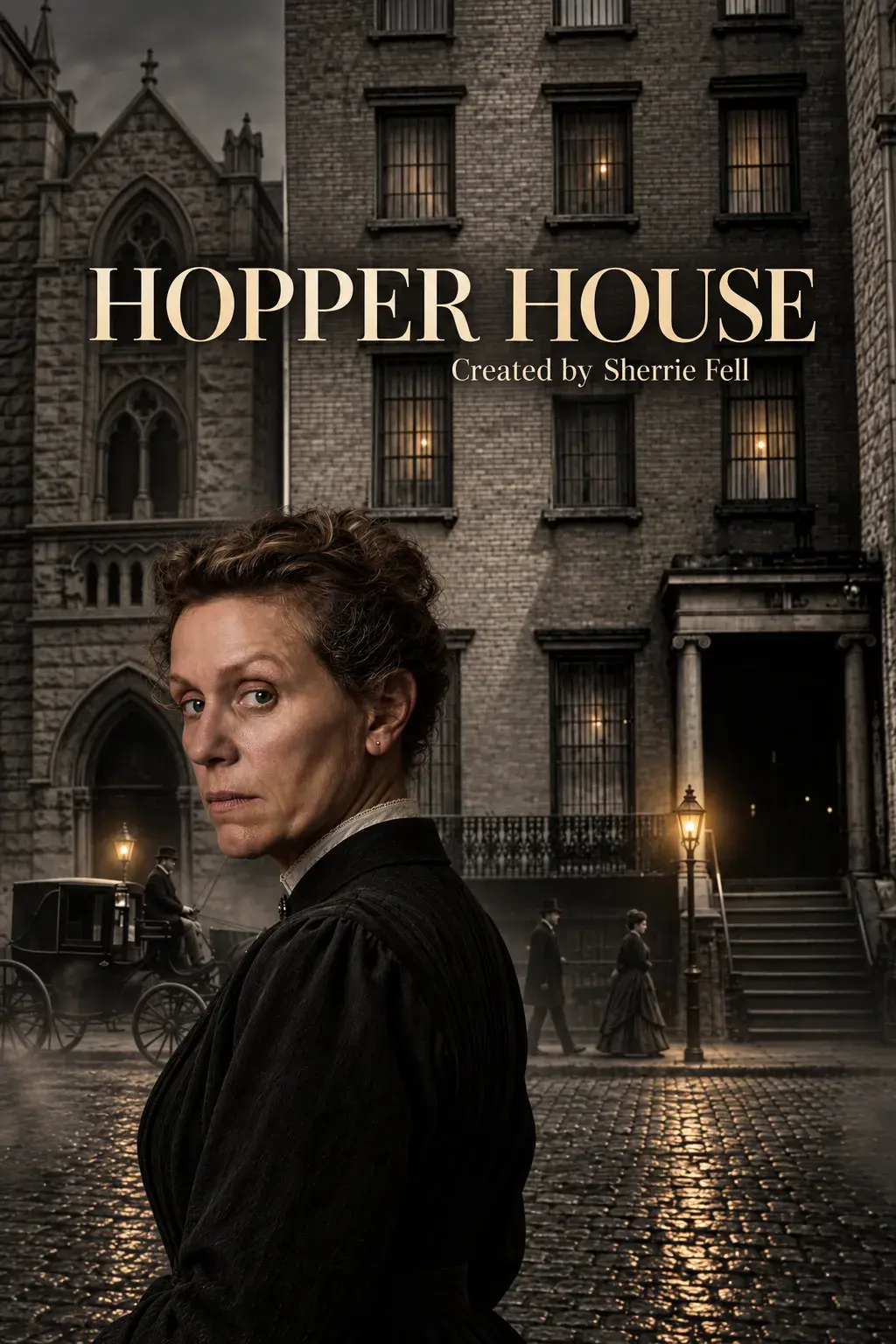
  • Poster artwork for the screenplay Hopper House

    Hopper House

    sherrie fell55 pages

    In 1850s Manhattan, reformer Abigail Hopper opens a radical halfway house for women released from prison, but each new arrival brings secrets, danger, and buried pasts making the refuge itself a battleground between redemption and a society determined to see them fall.

    Read the full pitch

    Short synopsis

    New York City, 1853. After Chinese immigrant Mei Ling is arrested during a police raid, she is imprisoned at Mount Pleasant alongside Ruth Ann Carter, a resourceful free Black woman living under the constant threat of being seized and forced into slavery, and Maeve Callahan, an Irish immigrant desperate to find the woman she loves. When Maeve defends Ruth from a violent guard, the prison’s complex and sadistic warden condemns her to a punishment that leaves her gravely ill. At Hopper House, a refuge for formerly incarcerated women, Quaker reformer Abigail Hopper Gibbons is fighting a political system determined to conceal and ignore the abuse occurring behind prison walls. Ruth and Mei are released into her care, but Maeve is secretly transferred to a quarantine island, where she is expected to disappear without scrutiny. Refusing to abandon her, Abigail authorizes a dangerous rescue. With help from Mei’s dockside connection and troubled physician Thomas Ellery, Ruth and Mei cross the East River, infiltrate the quarantine ward and smuggle Maeve out disguised as a corpse. Maeve survives, but safety proves temporary. As the police arrive at Hopper House, Mei’s former traffickers closes in, a seemingly charitable employer targets Ruth, and notorious fence Marm Mandelbaum draws a resident into her criminal network leaving the new arrivals’ refuge in jeopardy.

    Comps (comparisons)

    The Gilded Age meets Wentworth, with the unfiltered grift of The Knick.

    Like The Gilded Age, the series reveals the power structures beneath nineteenth-century New York but from the perspective of the lower classes; like Wentworth, it centers on a diverse ensemble of incarcerated and formerly incarcerated women; and like The Knick, it presents institutional cruelty, medicine and reform. Additionally, it echoes the gritty atmosphere, gaslit interiors and the raw unvarnished streets of New York City.

    The hook

    Based on the real Hopper House and inspired by historical figures including pioneering prison reformer and abolitionist Abigail Hopper Gibbons, Hopper House brings a little-known chapter of American history to life. Blending real people and institutions with fictional characters and storylines, the series reveals nineteenth-century New York through women rarely placed at the center of period dramas: formerly incarcerated women, immigrants, women of color, queer women, sex workers and thieves. The house is far more than a setting; it is a pressure cooker of last chances. Many of these women will be lost if they don't find their way. While it offers sanctuary, its residents remain fiercely pursued by political corruption, institutional cruelty, and the criminal underworld waiting just beyond its doors. Some women will form bonds, others will challenge the rules, return to crime or their abusive situations. The many worlds of prison, the halfway house and the streets will intersect to make an immersive portrait of survival in 19th Century New York City. At a time when incarceration, reentry, trafficking, racial injustice and women’s bodily autonomy remain urgent concerns, Hopper House shows that these struggles are deeply rooted in American history. It asks a question that still resonates today: Can a system created to control women ever become a place that truly sets them free?

    Scale / budget

    Mid-tier premium television drama.

    I would follow the physical blueprint of THE KNICK series: internal sets will be deliberately constructed to true, compact period dimensions. This choice naturally limits lighting setups by utilizing practical, localized sources like Edison-style bulbs and gaslight fixtures, which dramatically reduces crew setup times and electrical footprints while enhancing the claustrophobic, prestige aesthetic. While the production requires convincing nineteenth-century streets, prisons, waterfronts, boats, horses, costumes, and an ensemble cast thereby placing it well above a micro-budget scale.

    The recurring Hopper House, prison, and institutional interiors can be constructed as standing sets, (The Knick made those sets in Brooklyn) while controlled exterior locations and selective digital extensions can contain costs.

    Its strongest value lies in atmosphere, performance, and production design rather than spectacle, making it highly suitable for a prestige cable or streaming budget.

  • Poster artwork for the screenplay Missing Trio

    Missing Trio

    Gary B. Haley89 pages

    In 1974, three Fort Worth girls left their Christmas purchases inside their locked car and disappeared from a crowded shopping center, while a mysterious forged letter, countless conflicting stories, and lingering questions have left their families searching for decades.

    Read the full pitch

    Short synopsis

    Three Fort Worth girls go Christmas shopping two days before Christmas, 1974. None return. Seventeen-year-old Rachel Trlica drives fourteen-year-old Renee Wilson and nine-year-old Julie Moseley to Seminary South. By nightfall, Rachel’s Oldsmobile sits locked in the Sears lot, their packages still inside. There is no sign of a struggle, and no trace of the girls. Police consider them runaways—until one question shatters the theory: why would two teenagers disappear with a nine-year-old? Then a letter arrives, supposedly from Rachel, claiming they “had to get away,” are headed to Houston, and will return in a week. Its strange wording, uncertain handwriting, and formal address offer hope—and the chilling possibility that someone is buying time.

    For fifty years, the families chase every lead: a security guard, a late-night pickup, obscene callers, missing files, sightings across Texas, and cars dragged from a lake. In the present day, Rachel’s brother Rusty Arnold and Julie’s aunt Sandy Harkcom reopen the trail, separating fact from rumor and tracing claims to their sources. The deeper they dig, the more the case fractures beneath contaminated memories, contradictory witnesses, and evidence that may no longer exist. Moving between the girls’ vibrant final hours and the loved ones who refuse to surrender them, Missing Trio becomes a tense human mystery about truth, grief, and the terrible cost of uncertainty. Rusty and Sandy may not be able to bring Rachel, Renee, and Julie home—but they can rescue them from rumors and make the world remember their names.

    Comps (comparisons)

    Lost Girls meets Zodiac, with the family urgency of Changeling. These comparisons describe tone and storytelling approach, not identical plots. The Missing Trio story is unique and frightening.

    The hook

    Three girls—seventeen, fourteen, and nine—vanish during a Christmas shopping trip, leaving behind a locked car filled with gifts. The next morning, a letter supposedly written by the oldest claims they ran away to Houston, raising the chilling possibility that someone used her identity to buy time.

    Scale / budget

    Type Estimates Micro $262,646.50 Ultra-low $791,243.36 Low $2,290,193.88 Full Production $6,838,502.93

  • Poster artwork for the screenplay Servants of the Mother

    Servants of the Mother

    Michael Paskaru113 pages

    In 1980’s El Paso, a father helps his son fulfill his dying wish of becoming a cowboy in the Big Blue Carnival that happens only once a life-time.

    Read the full pitch

    Short synopsis

    In 1982 El Paso, Joel Jackson is a broken father haunted by the death of his wife, Joy, the mistakes that tore apart his family, and the terminal illness of his eleven-year-old son, Scotty. Desperate to save him, Joel raises thousands of dollars for a mysterious healer, clinging to the possibility of a cure. But Scotty has a simpler dying wish: to become a cowboy at the legendary Big Blue Carnival before it closes forever.

    When Scotty enters a scavenger hunt for the carnival’s final ticket, Joel is forced to confront what his son truly needs—and the fractured family he has spent years avoiding. As Scotty searches for the ticket, Joel reconnects with his estranged sons, Nathan, Caleb, and Luke, while the entire town rallies to save the struggling carnival.

    Scotty ultimately loses the contest, but the carnival’s organizers secretly keep the performers behind so he can experience it after closing. Dressed as a cowboy and surrounded by his reunited family, Scotty finally approaches the carnival—but dies moments before reaching it. Joel begins rebuilding his relationships with grieving honesty. The townspeople memorialize Scotty with a statue of him as the cowboy he dreamed of becoming, leaving Joel surrounded by the community and family he nearly lost.

    Comps (comparisons)

    Servants of the Mother is "Big Fish" meets "The Straight Story", with a touch of "The Fall". Big Fish is the closest tonal comp: an emotional father-son story involving terminal illness, estrangement, reconciliation, and a heightened, almost storybook Americana. The Straight Story matches the quieter themes of fractured family relationships, mortality, forgiveness, and a journey through rural America toward reconciliation. The Fall works for the more whimsical, child-centered side—the mixture of imagination, adventure, visual spectacle, and an underlying story about suffering and death.

    The hook

    A desperate father will do anything to cure his terminally ill son—but his son doesn’t want a miracle. He wants to become a cowboy at a legendary carnival before he dies. Servants of the Mother turns that simple wish into a bittersweet story about grief, fractured family, and the difference between keeping someone alive and helping them truly live.

    Scale / budget

    Mid-tier independent feature. The film is primarily an intimate, character-driven family drama, but its 1980s Southwestern setting and climactic Big Blue Carnival require enough production value to create a convincing period world and give Scotty’s final wish the visual scale it deserves. A roughly $5–15 million budget would allow the film to feel cinematic without sacrificing its intimate, human focus.

  • Poster artwork for the screenplay Lay at one's door

    Lay at one's door

    Amanda Jane Kendall141 pages

    When two children searching for their lost dog stumble upon a reclusive, foul-mouthed old woman living alone in a crumbling cottage, their disastrous first meeting grows into an extraordinary friendship that begins to heal wounds spanning three generations.

    Read the full pitch

    Short synopsis

    Two siblings, ginger-haired teenager Hilary and his younger sister Bobbie, stumble upon a reclusive elderly woman - Granny - real name Delores Pennington - living alone in a crumbling countryside cottage while searching for their dog. Initially terrifying, Granny reveals herself to be an eccentric, sharp-tongued animal rescuer carrying a lifetime of tragedy; her toddler son Jimmy drowned accidentally in 1963, after which her husband abandoned her and the community branded her a murderer. Despite a volatile start the children form a deep bond with Granny, sharing midnight skip-diving, dancing in the rain, and hard truths - including Hilary's shame over his father Paul, a soldier imprisoned for going AWOL, whom Granny helps him re-frame with compassion. When authorities discover Granny's cannabis plants and unregistered shot gun, she is forcibly placed in a care home, where she rapidly deteriorates, stripped of her animals, her freedom and her spirit. Hilary sneaks her back to the cottage one final night, and she dies peacefully in her chair holding a photograph of Jimmy. A letter she left the children leads the Haynes family - now reunited with Paul upon his release - to inherit her estate, which they transform into an animal rescue center, to honour the woman who taught them the true value of family, forgiveness and kindness.

    Comps (comparisons)

    Lay at One’s Door combines the warmth and emotional honesty of About a Boy with the eccentric, bittersweet humour of The Lady in the Van and the unconventional cross-generational friendship of Hunt for the Wilderpeople.

    The hook

    At its heart, Lay at One’s Door is about people we too easily judge by what we see on the outside. Granny appears homeless, difficult and even frightening; Hilary appears angry and troublesome. Yet behind both are stories of loss that nobody has taken the time to understand.

    What makes the story distinctive is the unlikely friendship between two children and an outrageous, fiercely independent woman in her late eighties who has rejected people but devoted her life to rescuing animals. Their relationship is funny, confrontational and sometimes chaotic, but ultimately transformative.

    At a time when loneliness, fractured families and divisions between generations are increasingly visible, Lay at One’s Door is a reminder of what can happen when we look beyond appearances and allow people into our lives. It explores grief and isolation without losing its humour, and asks a simple question: how differently might we treat someone if we knew the story that brought them to our door?

    Scale / budget

    I see Lay at One’s Door as a mid-tier British feature. The story is character-led and grounded, with no reliance on expensive visual effects or large-scale action, while its woodland setting, Granny’s cottage, animals and ensemble cast give it a rich visual world. Its scale allows the focus — and the investment — to remain where it matters most: strong performances, atmosphere and the emotional relationships at the heart of the story.

  • Poster artwork for the screenplay The Crown of Ash

    The Crown of Ash

    Mahmoud Geldonne55 pages

    A retired enforcer, presumed dead and now living quietly with his homicide detective wife, is forced back into the underworld when a mysterious group assassinates four crime lords and her investigation into the explosion brings her dangerously close to the man she married.

    Read the full pitch

    Short synopsis

    The Crown of Ash follows Diego Cortés, a quiet London novelist living peacefully with his wife, Detective Isabella Ashford Cortés. However, Diego is not who he claims. His real name is Diego Montoya, eldest son of London's most powerful crime family, once known as El Diablo, the city's most feared enforcer.

    Years ago, he faked his death and took the identity of his best friend, a man who believed in redemption. Now he lives a borrowed life, his past buried, his marriage everything. When an explosion kills London's four syndicate leaders in one night, chaos erupts. Isabella is assigned to hunt the killers, the Ash Circle, unaware her husband is tied to the killers she investigates. As whispers spread, "El Diablo has returned, Ash Circle takes the Crown", Diego is forced back into the life he abandoned.

    A dangerous cat and mouse game unfolds. Diego tracks the organization threatening his quiet existence while Isabella's investigation pulls her closer to the truth. Every clue brings her nearer to the man she married, every step Diego takes threatens to burn their marriage to ash. Confronting the ghosts of his past, Diego faces an impossible choice. The peaceful man he chose to become, or the ruthless figure he once buried.

    The Crown of Ash is a psychological crime thriller about identity, loyalty, love and the impossibility of escaping the past.

    Comps (comparisons)

    It's The Americans' marriage of lies colliding with Gangs of London's underworld warfare with a Peaky Blinders style family dynasty pulling the strings.

    The hook

    What makes The Crown of Ash different is that it's not just another cat and mouse crime thriller, it's a tragedy about identity. You've got two protagonists who mirror each other. A retired enforcer, Diego and his detective wife Isabella, both hiding violent pasts, both trying to be better than they were in the past, and both heading toward the same truth that they have tried to outrun. The antagonist isn't some power hungry villain. He's a broken brother who kills four leaders, including his own father, and engineers everything in the background not for control, but because he genuinely believes only his sibling can restore order. Add in a fake cult designed by the antagonist to mess with people's heads, a best friend whose betrayal dies with her, and an ending where the hero doesn't win, he just stops running from who he really is for the sake of his love and you've got a show that isn't about whether the protagonist gets caught. It's about whether a marriage built on secrets can survive the truth and whether two people who lied to each other, and to themselves, can ever find their way back.

    Scale / budget

    To be honest, I don't have much experience with scale and budget. My focus has always been on crafting the story and letting it breathe, so that when people finally watch it, they can feel how beautiful it is. If I had to give my input, I'd say mid-tier scale and budget. I know filming in London would drive costs up, but this is a character driven story, not a flashy show of police chases and constant explosions. I believe the right actors and the right setting are the heart of The Crown of Ash, that's where the investment should go. What I'm really looking for is someone who can mentor me. Someone who can teach me how to make Crown of Ash a potential hit that rivals Peaky Blinders but also take me under their wing so I can grow as a writer and bring other ideas to life down the line.

  • Poster artwork for the screenplay Hit Me Episode 07 "A Coffin for Two"

    Hit Me Episode 07 "A Coffin for Two"

    Alex Brown60 pages

    At his gangster best friend’s funeral, a champion boxer uses the coffin as a hiding place and himself as bait in one final attempt to survive the assassin he once hired to kill him.

    Read the full pitch

    Short synopsis

    Roman Rock is dead, but the hit he ordered on his best friend, Barney Wild, is still very much alive. At Roman’s funeral, Barney knows the professional assassin hunting him may finally make his move. With nowhere left to run, an extraordinary plan is put into action: Barney will be used as bait. As tensions explode outside the funeral into a full-scale riot, Junior disguises himself as Barney while the real Barney takes refuge in the last place anyone would think to look inside Roman’s coffin. But the hitman isn’t fooled for long. Junior is shot, Barney is discovered, and the confrontation moves inside the church. Just as it appears the assassin will finally complete the contract Barney once placed on his own life, a gunshot ricochets and severs the wire supporting a giant crucifix. It crashes down, killing the hitman. In a final piece of macabre justice, the man Roman hired to kill his best friend is placed inside Roman’s coffin beside him. Two dead men. One coffin. And Barney Wild, the man who once wanted to die, finally walks away alive. But Roman’s death has left a vacuum in Edinburgh’s criminal underworld, and the consequences are only beginning.

    Comps (comparisons)

    COMPS / CREATIVE DNA PEAKY BLINDERS meets GUILT, with the working-class heart and dark humour of SHAMELESS. Like Peaky Blinders, HIT ME combines crime, loyalty and larger-than-life characters; like Guilt, it finds dark humour inside increasingly dangerous situations; and like Shameless, its heart lies with flawed, funny and fiercely loyal working-class characters.

    The hook

    HIT ME begins with an irresistible dramatic question: what happens when a man orders his own assassination, and then discovers he isn’t dying? A Coffin for Two takes that premise to its most cinematic and darkly comic extreme. A funeral becomes a trap, the hero hides inside his dead gangster best friend’s coffin, an assassin closes in, and tragedy, violence and absurd humour collide inside a Scottish church. But beneath the crime thriller is a story about something much more human: friendship, grief and discovering the value of life when you thought you were ready to give it up. HIT ME is rooted in a working-class Edinburgh rarely placed at the centre of returning television drama. Its characters can be frightening, ridiculous, heartbreaking and funny within the same scene, and Scotland isn’t simply the backdrop; it’s a character in its own right. At a time when audiences respond to distinctive regional voices and character-led crime stories, HIT ME offers a world that can continue far beyond one season. It’s a love letter to working-class Scotland disguised as a darkly comic gangster thriller.

    Scale / budget

    SCALE / BUDGET Mid-tier returning television drama - 8 x 60 minutes. HIT ME is designed as a premium but achievable character-led crime series. Its principal production requirements are practical locations across Edinburgh and Scotland, an ensemble cast, limited action/stunt sequences and occasional larger set pieces. A Coffin for Two contains one of Season One’s major set pieces, Roman’s funeral, the exterior disturbance and the climactic confrontation inside the church, but the series is driven primarily by character, performance and story rather than expensive VFX. FULL SERIES PACKAGE AVAILABLE ON REQUEST: Complete 8 x 60' Season One scripts, Series Bible, Treatment/Presentation and teaser trailer.

  • Poster artwork for the screenplay The Halo

    The Halo

    Effi Schapira9 pages

    In a sunless dystopia where biometric forehead chips designate predator or prey, an enslaved woman executes her master - only to find an unseen force is erasing the bodies, enabling her to orchestrate an armed rebellion.

    Read the full pitch

    Short synopsis

    In an endless twilight granting only two hours of daily sunlight, society is brutally divided by glowing biometric implants: slaves wear the Green Halo- a target marking them as open prey- while ruling Lords command the darkness with weapons and absolute impunity. The only legal sanctuary is the Blue Halo, granted exclusively to property claimed by a Lord. When Elena, an enslaved young woman, is ambushed and dragged into a Lord’s estate, she refuses to break. Playing a calculated psychological long game, she secretly poisons his food. As fever consumes him, she manipulates him into overriding her chip to Neon Blue so she can fetch medication without being executed in the streets. Protected by her new status, Elena leads him to a stone bath, draws his sidearm, and shoots him dead.

    Comps (comparisons)

    It's Love, Death & Robots (specifically Sonnie's Edge) meets Blade Runner and The Handmaid's Tale. Tone & Audience: It combines the visceral, photorealistic CGI grit and kinetic pacing of adult animated anthologies with the sharp psychological class rebellion and oppressive world-building of modern dystopian thrillers.

    The hook

    The High-Concept Twist: Unlike traditional dystopian survival stories centered on escape, THE HALO subverts the trope with "The Unseen Cleaner". The protagonist isn't evading the system; she realizes an invisible algorithm or hidden authority is actively sanitizing her crime scenes, converting her desperate act of self-defense into an engineered culling of the ruling class. Why Now: In an era increasingly shaped by automated surveillance, algorithmic control, and rigid social divides, the film explores how marginalized subjects can hijack the very mechanisms of their oppression and turn systemic tools back against their masters.

    Scale / budget

    Category: Mid-tier Independent Animated Short / Proof of Concept (High-End CGI). Production Scope: Conceived as a focused, self-contained 12-15 minute short film built in Unreal Engine 5.4 and Houdini. By utilizing a tightly contained set architecture (a dark alley, a luxurious mansion hall, and a stone bathroom), the production maximizes studio-grade visual fidelity and volumetric lighting without requiring expansive, budget-prohibitive environment asset loads. It serves both as an award-ready standalone short and a modular proof-of-concept for a serialized anthology episode or feature.

  • Poster artwork for the screenplay Rocky Roads

    Rocky Roads

    Ben C. Fordham113 pages

    After his six-year-old daughter is murdered, a grieving father sets out to kill her murderer, unaware that God has chosen him as a modern-day Job—and that choosing revenge over forgiveness will condemn humanity to extinction.

    Read the full pitch

    Short synopsis

    Rocky Rhodes is a devoted single father and criminal lawyer whose six-year-old daughter, Ambrosia, is murdered. Consumed by grief, Rocky loses his career, his home and nearly his life before setting out to find her killer.

    What Rocky doesn't know is that his suffering is no accident. God has chosen him as a modern-day Job—the latest subject in a bi-millennium cosmic test to determine humanity's fate.

    Watching from above are Tom and Dick, irreverent celestial agents who manipulate Rocky's life like a cosmic chess match. If Rocky chooses revenge, humanity ends. If he overcomes his rage, it survives.

    Tom and Dick's testing agent on Earth is Angel, an immortal assigned to lead Rocky to his daughter's murderer, Dillinger, make Rocky fall in love with her, then betray him. But after millennia of observing humanity, Angel unexpectedly falls in love with Rocky and chooses to sacrifice her immortality to help him.

    Their paths converge beneath the towering Grace Cross, where Rocky instinctively shoots Dillinger, disrupting the celestial test: was it vengeance or simply reaction? God allows the test to continue.

    Moments later, Rocky provides the answer, sacrificing his own life to save Angel. His final act of selfless love convinces God that humanity deserves another two thousand years.

    Comps (comparisons)

    Death Wish meets The Adjustment Bureau, with the metaphysical whimsy of Defending Your Life: a supernatural drama combining a grieving father's thirst for revenge with celestial forces manipulating human events, while exploring larger questions of fate, free will and redemption.

    The hook

    Rocky Roads turns a deeply personal revenge story into a cosmic referendum on humanity. A grieving father believes he is simply hunting the man who murdered his six-year-old daughter, unaware that he has been chosen as a modern-day Job and that his response to unimaginable loss will determine humanity's fate. The film explores grief, faith and free will without treating them solemnly. Two irreverent celestial agents manipulate events from above, while the immortal woman assigned to test and betray him unexpectedly falls in love with him and chooses to sacrifice her immortality to help him. Her exercise of free will ultimately sets the stage for his own. In a culture that often equates strength with striking back, Rocky Roads asks whether vengeance can heal profound loss—or whether our humanity is ultimately defined by our capacity, even at our darkest moment, to choose selfless love.

    Scale / budget

    Mid-tier feature. Rocky Roads is primarily a character-driven contemporary drama/thriller with contained supernatural elements, practical action and a manageable principal cast. Its celestial world and time-manipulation sequences require selective visual effects rather than large-scale spectacle. I envision an approximately $10–15 million production, depending primarily on cast.

  • Poster artwork for the screenplay TIME TRAVELLER

    TIME TRAVELLER

    Kerstin Schuetze138 pages

    To secure Kurt Gödel's scientific estate, an archivist must win over his foul-mouthed widow and uncovers how a cabaret dancer's love and Einstein's friendship rescued the logician from paranoia, until he put Einstein's own theory to a risky test.

    Read the full pitch

    Short synopsis

    Princeton, 1978. Kurt Gödel, the greatest logician since Aristotle, has starved himself to death, and his foul-mouthed widow Adele threatens to burn his papers. Sent to secure his estate, IAS archivist Mary Ann wins her trust visit by visit. Slowly, the widow begins to talk. As civil war spreads through 1930s Vienna, young Gödel shatters the foundations of mathematics and falls for the married cabaret dancer, to his family's horror. When his Vienna Circle mentor Moritz Schlick is shot by an antisemitic student, Gödel lands in a sanatorium, mistreated with insulin-shock therapy. Only Adele's devotion, and later in Princeton his friendship with Albert Einstein, bring him back to life. Unlike many IAS colleagues, Gödel refuses to work on the Manhattan Project. Mary Ann discovers why: studying the U.S. Constitution obsessively, he found a loophole that could let America, too, slide legally into dictatorship. Under FBI surveillance, his paranoia deepens. Yet for Einstein's 70th birthday he puts the Nobel laureate's own theory to a risky test: a rotating universe in which time travel is possible. The result challenges our notion of time, and from here the film's timelines bleed into one another. Fearing for his reputation, Einstein humiliates his friend before the scientific establishment. Dismissed as a fool, Gödel withdraws and stops eating for good. Adele's grief heals only when Mary Ann finds his logical proof of the existence of God, formally verified decades later. It holds a quiet promise that Adele will see him again.

    Comps (comparisons)

    "A beautiful mind" meets "Fried Green Tomatoes". The Austrian answer to "Oppenheimer" based on research at the IAS and true events.

    The hook

    In September 2026, AI agents asked to look up statistics broke into Australia's Medicare system. Nobody told them to. Nobody told them NOT to. Every machine is built on mathematics, and Gödel proved roughly 100 years ago that no system can see all of its own truths from within. He also found the loophole through which a democracy can legally become a dictatorship. And with Trump in office we see he was right to warn the people around him. Our film opens on the punch cards of a loom, the ancestor of the computer. But its heart is Adele, the foul-mouthed cabaret dancer history forgot, who tasted every meal before he would eat it. The machines of our age have exceptional brains. But what they lack is someone they would stop for.

    Scale / budget

    It's a mid-tier feature, best suited to a European–US or GB co-production. The script spans from periods of the 1930s Vienna, to Princeton in the 1940s but is told from the perspective of 1978. It includes riot scenes, a burning Palace of Justice, and stylised VFX sequences (the Escher train and the cosmos). Its emotional core is intimate, though: two women in a nursing-home room. That keeps the budget contained and makes the film well suited to public film funding. The budget currently estimated is approx. 10 to 12 Mio EURO. An Austrian producer showed interest, and the project was funded twice by the Austrian Film Commission. I am interested in a professional UK producer review.

  • Poster artwork for the screenplay Reversers

    Reversers

    Dominick Attilio42 pages

    Rowan and Knox are two low-lifes that use their laundromat as a decoy for their actual business: fixing strangers' issues using their unique ability of time travel. However, they're more in the business of making money instead of helping people.

    Read the full pitch

    Short synopsis

    Rowan, a stubborn genius that's created time travel, and his associate Knox, a well-intentioned fool, run a time-hopping business known as The Reversers, where they fix their customers' personal issues. Their latest customer, Sal, has lost it all betting on horses. A mysterious stranger, only known as Jackpot, hands Sal a business card and tells him that The Reversers can prevent Sal from placing that horrific bet. Once enlisted to help, Rowan and Knox travel to the past using their time machine, which is disguised as a washer and dryer. What follows is a hilariously poor attempt to help Sal, leading to a chain reaction of events resulting in Rowan and Knox accidentally kidnapping Sal's baby. We see how odd this odd couple is as they are forced to bring the baby along on their dangerous mission, revealing the chaotic nature of their relationship. Once the issue in the past is resolved, Sal repays them and tells Rowan and Knox who referred him. The name "Jackpot" means nothing to them, and they are thrown for a whirl when they see the business card Sal has. However, Rowan and Knox have never given out a business card, setting up the season-long mystery of who Jackpot really is, and why he is setting out to potentially destroy the business.

    Comps (comparisons)

    "Reversers" is a half hour sitcom combining the wacky humor of "Community," the buddy cop dynamic of "Supernatural," and the bright and whimsy science fiction of "Back to the Future."

    The hook

    These days, it feels like one mistake could cost you everything, but what if there was a business that specializes in undoing the little stuff that feels so world-ending? That's where the Reversers come in, two dimwitted time travelers that can fix those everyday mishaps the average person can make. Wish you didn't eat that leftover Chinese food? Call the Reversers. Wish you didn't make that political comment in front of your coworkers? Call the Reversers. Wish you didn't fart in front of your date? Call the Reversers. The only issue: the Reversers tend to make their customers' lives worse in some other way. Through every misadventure, the relationship between our leads will be tested, unraveling the nature of their friendship and the potential dangers of their job. At the moment, there's not a series that mixes a comedic, odd couple with a sci-fi twist, leaving a void for the general audience; not to mention, the overarching mystery that is actively threatening the livelihood of our main duo. This is the kind of comedy/sci-fi/mystery show that could get audiences theorizing on a weekly basis.

    Scale / budget

    This series requires, at the very least, the micro-budget of an indie film. Its main set piece is the laundromat the two main characters work at, with all other set pieces easily filmable on location or with pre-made sets at a studio.

  • Poster artwork for the screenplay GIROLAMO SAVONAROLA & THE TRIAL OF FIRE

    GIROLAMO SAVONAROLA & THE TRIAL OF FIRE

    Giampietro Manzalini99 pages

    At the end of the XV Century, a Dominican friar attacks the corrupted and libertine lifestyle of the Roman Church.

    Read the full pitch

    Short synopsis

    Girolamo Savonarola, a young Dominican Friar, returns to Florence summoned by Lorenzo de’Medici to hold preachings, clashing with the local power. After Lorenzo’s death, he attacks Pope Borja’s and the Roman Curia’s libertine and corrupted lifestyle. His boldness will take him to martyrodom.

    Comps (comparisons)

    The Borgia

    The hook

    Savonarola was a precursor to Martin Luther's Reformation; his works were banned by the Roman Church for 300 years. His beatification remains stalled in Rome.

    Scale / budget

    Mid-tier feature

  • Poster artwork for the screenplay FERRARA AND THE YOUNG BALBO

    FERRARA AND THE YOUNG BALBO

    Giampietro Manzalini105 pages

    The Birth of Agrarian Fascism.

    Read the full pitch

    Short synopsis

    Remo returns home after WWI solely desiring to make a life with his fiancée Lucia but finds his city, Ferrara, disrupted by clashes between socialist leagues and tenants, sharecroppers, landowners. After falling victim of Socialist Red Guards violence, Remo joins the emerging Fasci di Combattimento to defend his land, himself and his family. He slowly becomes the right hand of his former Captain Italo Balbo. The carnage of Piazza D'Accursio (Bologna) as well as the massacre of Castello Estense (Ferrara) are the reasons for Italo Balbo's descent into political contention and get Mussolini’s trust. The novel is based on historical events that have fallen into oblivion. Only Remo, Lucia and their families are fictional, serving the story to narrate the climate and daily life during the so-called “Red Biennium” and “Black Biennium.”

    Comps (comparisons)

    La lunga notte del'43 di F.Vancini

    The hook

    Real events that history would like to consign to oblivion.

    Scale / budget

    Mid-Tier feature

  • Poster artwork for the screenplay Ego Dystonic

    Ego Dystonic

    Joseph Baskin100 pages

    A young, sexually frustrated Sigmund Freud navigates the family dynamics of an uber wealthy arms manufacturer who seeks treatment for his ailing daughter - all the while high on cocaine.

    Read the full pitch

    Short synopsis

    It is1885 and Sigmund Freud is a resident doctor at the Vienna Krakenhaus. He just published the definitive work on cocaine, a revolutionary drug he believes holds the key to solving many ailments, including his own. Despite this, he can’t find meaningful employment, and thus his beloved Martha must remain in her parents house.

    Johann Schwarzwald, powerful head of Schwarzwald Steel, seeks to move the company to arms manufacturing. He is fraught with insecurities given his own secret heritage. His son, Max, heir apparent, battles obsessive oddities and his unhealthily attachment to his reclusive, bedridden mother, Cristina. Max’s wife, Ophelia, bristles at traditional roles, reads Darwin and is eager to challenge young Doctor Freud. Greta, Johann’s eldest daughter is the get along type; her husband Paul seeks to improve his own neutered position within the company. Their son Freddy, 17, is a pyromaniac and serial masturbator. Cristof, Johann’s younger unmarried brother loves two things:the bible and innovating weapons. And then there’s Heidi - beautiful and mentally unstable, plagued by behavioral explosions and unexplained maladies - a veritable siren for Freud’s frustrated libido. When she is arrested for indecent exposure, her father reaches out to the creme de la creme of the Viennese medical community for help. A little known Sigmund Freud is tasked with finding a cure for young Heidi.

    Faced with his own insecurities, sexual frustration, and an escalating cocaine dependence that threatens his hold on rationality, Freud must navigate intricate family dynamics to effect a cure for Heidi.

    Comps (comparisons)

    Amadeus A Dangerous Method The Death of Stalin (serious topic with dark comedy overtone)

    The hook

    Crisp dialogue with multiple voices that are distinct and compelling. There is enduring interest in the human psyche and a deep dive in individual personalities and their treatment. Freud, always a fascinating character, hasn't been explored in this early stage of his career where he struggled and was hooked on cocaine at the same time. The writer is a psychiatrist with 20+ years experience. He brings authenticity and a keen eye for how Freud might have come to fall in love with his life's work.

    Scale / budget

    Mid-tier or large studio. Costume design and a brief set-up of late 19th century Vienna are major costs. Most of the action takes place in an estate manor and this will help with expenses.

  • Poster artwork for the screenplay Aurora Sky

    Aurora Sky

    Eleanor Veness60 pages

    "After her husband mysteriously dies on their wedding day, Noor is haunted by Aster's apparition. A strange man convinces Noor to journey to the Underworld and revive Aster in the flesh. Expecting a baby, Noor must resist temptation to look back.”

    Read the full pitch

    Short synopsis

    NOOR sits in a graveyard, cries. The gravestone reads: ‘ASTER JAMES VITALIS. 1987 - 2024’. Noor strokes her large, heavily pregnant bump. A cat circles her. Noor responds to the creature wit familiarity, follows the cat toward a clearing in the shadows: ‘THE CERBERUS ARMS - Welcome to the Underworld!’ A shadow of a man stands in the porch way: DAN THE BILLBOARD MAN. Noor cannot turn to look into Aster’s eyes on returning to the living world. Noor accepts, makes her first step. Noor and Aster’s small wedding ceremony in a church; witnessed by NELL, Noor’s foster Mother, ANDROULLA, Aster’s Grandmother and ADAM the best man. The rings are exchanged, followed by the kiss. The wedding reception: A celebratory explosion of people, dancing, drinking, confetti thrown. Noor declines a cigarette Aster offers, makes the announcement that she is pregnant. Inside: A shadowy figure of a BARMAN serves Aster and Adam snakebite shots. Aster starts to mysteriously choke, runs outside. Aster collapses, dies. Aster’s funeral. Noor watches Aster’s casket: the new, APPARITION ASTER, emerges. He tells Noor that she is the only person who can see him. After the service, NELL and NOOR agree that she is coming to live with her in Noor’s childhood home of the Phoenix Centre for refugees. Noor performs, plays her qanun in a market square, busks. DAN THE BILLBOARD MAN approaches, he knows about Noor’s deceased husband. Dan asks Noor if she wants to see Aster again. She replies, “of course I do”. Dan the Billboard Man tells Noor to call him to receive instructions on how to enter the Underworld. Dr. LINDA ALOKA and Noor in the psychiatrist’s office. Dr. Aloka is concerned about Noor’s visions. Apparition Aster watches them. Noor admits that she can see Aster as though he were there with her; Apparition Aster disappears at this moment. Dan the Billboard Man appears to Noor in visions around Kingston town centre. Dr. Linda Aloka calls Nell, tells her that Noor is being prescribed antipsychotics. Noor holds the mysterious phone number in her palm, calls it. Dan the Billboard Man answers the phone, instructs Noor to the war memorial in town and look for a black cat; bring her qanun. The black cat will guide her to the Underworld. Noor faces the THREE-HEADED DOG, animate, difficult to get past. Noor plays her instrument, lulls them to a calm sleep. Noor seizes the opportunity to step forward. A large nightclub. Across the dance floor is Aster. Noor tells Aster that she has come to rescue him. Aster tells Noor that he wants their unborn daughter to be called Aurora. There is a dock of small boats with oars. As they drift to the human world, Noor looks back at him, Aster disappears. Above on the bridge, Dan the Billboard Man declares his obsessive love for Noor, tells her that he killed Aster, proposes to Noor; she defiantly refuses. Dan metamorphoses into a black cat, runs away. Noor is on a hospital bed, gives birth to the child: Aurora Sky Vitalis. Two years later. Noor attends Aster’s grave; leaves a bouquet of red roses. AURORA, 2, toddles through the grass, points, "Mama! A cat!" Out of the corner of Noor's eye, the tail of a black cat whips in the growth.

    Comps (comparisons)

    'PAN’S LABYRINTH' & 'KAOS' MEETS, 'I WILL DESTROY YOU'

    The hook

    Noor must come to terms with her pregnancy and her future and in doing so confronts her murky past and her grief; she risks her welfare of that of her unborn baby in the drive to bring her deceased husband back from the grave. Aurora Sky plays with representations between mythology, present reality and magical realism, in which the Gods become flesh. Set in Kingston, Surrey, United Kingdom. Modern day. The story also tackles the highly current topic of refugee rights in the UK, exploring mental health and generational trauma. The story has a strong, female protagonist. Animation and puppetry features within the film, representative of the otherworldly aesthetic of the underworld. Its theme of looking back in retrospect echoes that of the ‘Orpheus’ myth.

    Scale / budget

    Large Feature with Studio involvment. DEVELOPMENT & CREATIVE SCALE (ATL ESTIMATE) - TIER 1 INVOLVES: Story & Screenplay. Directing & Producing Team; Indie Producers - Hybrid/Animation experience. Specialized voice/Physical talent. PROJECTED BUDGET: EST. £2M

  • Poster artwork for the screenplay WHO KILLED DON MINZONI ?

    WHO KILLED DON MINZONI ?

    Giampietro Manzalini114 pages

    Social struggles in Italy at the end of WW I.

    Read the full pitch

    Short synopsis

    A young priest , Don Giovanni Minzoni, is nominated Chaplain in Argenta where the Socialist Leagues are in control. Initially viewed with suspicion by the community, he manages to instil affection. He dedicates his time especially to young people . Forced to go into WWI, he is awarded the Medal of Military Valour. On his return, Argenta is torn apart by fighting between the Socialists and the Fasci Fighting Bands lead by ITALO BALBO. Don Minzoni founds the Young Catholic Explorers (Scouts), but his opposition to the Young Fascist Vanguard drives him to the fatal ambush in a sultry summer night in 1923. The brutal attack upsets the leaders of Fascism in all Ferrara and the news reverberates all over Italy. In the course of their investigations a young Magistrate, a stubbon lieutenant of the Carabinieri and the editor of IL POPOLO newspaper have trouble navigating the institiutions controlled by the Fascist Regisme. The trials of ’24 and ’25, which ended with absolutions and that of ’47, will not suffice to reveal the truth. The suspects who were still alive benefitted from the Togliatti Amnesty, for crimes of the Fascist Regime.

    Comps (comparisons)

    Il delitto Matteotti (1973) di F.Vancini

    The hook

    An account of the atmosphere that took hold in the city. The investigations that led to the three trials.

    Scale / budget

    Mid-tier future

  • Poster artwork for the screenplay Elven

    Elven

    Matthew Tallacksen113 pages

    When an overprotective mother and her impulsive teen daughter travel to Scotland to retrieve an unexpected inheritance, a necklace that has been lost for hundreds of years leads them into a mystical and dangerous adventure as they are thrust into a centuries-old battle waged between families.

    Read the full pitch

    Short synopsis

    Elven tells the story of Kate and her daughter Abby, and their adventure in Scotland after receiving news of an inheritance. Their trip quickly takes a mystical but dangerous turn when Abby finds a necklace that's been missing for centuries. As they begin to manifest extraordinary abilities, mother and daughter must decide whether to embrace their ancestral destiny or return to the safety of their life in New York. Kate's journey is truly inspiring as she surprises even herself by tapping into her growing confidence. Within this fantastical family adventure, there is an empowering story about a mother and daughter discovering everything they're capable of when thrown into an exciting but perilous journey alongside a hidden world of characters. Elven blends folklore, family drama, and coming-of age magic in a heartfelt fantasy tale steeped in Scottish mythos. The concept elevates the family genre by offering new and fresh perspectives. The themes touch on the bond between mother and daughter, the weight of responsibility, and finding courage within oneself.

    Please see Pitch Deck Below.

    Comps (comparisons)

    Locke and Key meets Onward. Willow meets Brave. Spiderwick Chronicles meets Hocus Pocus.

    Please see Pitch Deck Below.

    The hook

    There is always one thing that we want as a child. Elven brings those dreams to life. All the amazing movies we love, connect us with our life-long secret wishes. Let's get lost for just a few hours and feel those childhood dreams again.

    Please see Pitch Deck below.

    Scale / budget

    Mid-tier Feature - 8 to 12 million. A large studio may see Franchise potential, and spend more.

    Please see Pitch Deck Below.

  • Poster artwork for the screenplay The Quest to Overthrow Heaven

    The Quest to Overthrow Heaven

    Bolko Zimmer110 pages

    “The Quest to Overthrow Heaven” offers a powerful reading experience that explores the unseen war between good and evil – and the consequences of choosing pride over purpose.

    Read the full pitch

    Short synopsis

    “The Quest to Overthrow Heaven” delivers a dramatic, spiritually charged reading experience rooted in Christian life themes and the reality of spiritual warfare. Centered around Lucifer’s rebellion, the story draws readers into a high-stakes conflict that reveals how pride, deception, and ambition can lead to devastating consequences in both the physical and spiritual worlds.

    Comps (comparisons)

    None.

    The hook

    The story explores the cost of resisting – or surrendering to – darkness. The story challenges readers to think about courage, obedience, humility, and the power of truth that affect both the physical and spiritual worlds.

    Scale / budget

    Feature.

  • Poster artwork for the screenplay The Hall of Forgotten Dreams

    The Hall of Forgotten Dreams

    Asia Charice Schmidt6 pages

    After abandoning her dream of becoming a writer, a young girl awakens inside a mysterious hall where forgotten dreams are cataloged and destroyed. When she discovers her own unfinished future is next to be cast into the abyss, she must reclaim it before it is lost forever.

    Read the full pitch

    Short synopsis

    After being told that writing is not a real career, a discouraged young girl begins to question her talent, her future, and whether her dream is worth pursuing at all.

    That night, she awakens inside the Hall of Forgotten Dreams, a vast realm where abandoned ambitions are transformed into glowing scrolls and stored among endless shelves that stretch beyond sight. Every scroll contains a future someone almost lived. Every whisper carries the regret of a dream left behind.

    As she ventures deeper into the Hall’s winding corridors, forgotten archives, and processing chambers, she encounters the Minions, mysterious figures who collect, catalog, and dispose of abandoned futures. Once dreamers themselves, they now carry the fears and compromises that caused them to surrender their own ambitions. Convinced that disappointment is inevitable, they encourage others to make the same choice.

    When the young girl discovers a scroll connected to her own unfinished future, she learns it is marked for disposal. As it inches closer to the abyss, she is forced to confront the same doubts that claimed countless dreamers before her.

    To reclaim her scroll, she must choose between the safety of letting go and the uncertainty of beginning again. In doing so, she discovers that dreams are rarely lost in a single moment. They are surrendered through fear, practicality, and the belief that there will always be more time.

    When she finally chooses belief over doubt, she becomes the first dreamer to reclaim what was almost lost and awakens with the courage to write the first words of the story she nearly abandoned.

    This story is for anyone who has ever set aside a dream, questioned their purpose, or wondered how their life might have unfolded if they had chosen differently. It is also a reminder that our dreams do not exist in isolation. The stories we tell, the gifts we share, and the callings we pursue have the power to impact others in ways we may never fully understand.

    At its heart, The Hall of Forgotten Dreams is not simply about following a dream. It is about reclaiming possibility, confronting regret, and recognizing that the future is shaped by the choices we make today. In a time when so many people feel disconnected from purpose, the story offers a hopeful reminder that it is never too late to begin again.

    Comps (comparisons)

    Imagine the emotional depth of Inside Out, the imaginative world-building of Coraline, and the exploration of purpose found in Soul, woven into a story about the dreams we abandon, the lives we almost live, and the choice to begin again.

    The hook

    Have you ever wondered what happens to a dream when you stop pursuing it? Where does it go? Who is impacted when you abandon the very thing you were created to do? The Hall of Forgotten Dreams imagines a world where abandoned dreams do not simply disappear. They are collected, cataloged, and stored within a vast hall filled with glowing scrolls, each one representing a future someone almost lived.

    Scale / budget

    Independent animated short film with franchise and anthology potential. The Hall of Forgotten Dreams is designed for scalable independent production. The story unfolds primarily within a contained fantasy environment, reducing the need for multiple locations while allowing for rich visual storytelling. With a focused cast, a limited number of speaking characters, and a world built around a single core setting, the project can achieve a cinematic feel without the production demands of a larger animated feature.

    Its contained scope, emotionally driven narrative, and visually distinctive world make it well suited for festivals and cross-generational audiences. The Hall also offers opportunities for future expansion through additional stories exploring purpose, possibility, identity, and the choices that shape our lives.

  • Artwork for the screenplay Flame of the Iceni

    Flame of the Iceni

    Laura J. Harris60 pages

    When Rome destroys the Iceni royal family, Aeronwen, daughter of Boudica, becomes the reluctant leader of a rebellion that could bring an empire to its knees—but her growing love for a Roman woman may cost her everything.

    Read the full pitch

    Short synopsis

    60 CE. Roman-occupied Britannia.

    When Roman forces betray the Iceni and brutally assault her family, Aeronwen — daughter of Queen Boudica and heir to the Iceni throne — is thrust into the heart of a rebellion that will shake the Roman Empire.

    As tribes unite behind her mother’s banner, Aeronwen must navigate war, political intrigue, and forbidden love while confronting a devastating question: how far can she go in pursuit of justice before she becomes the very thing she is fighting against?

    Set against one of history’s greatest uprisings, Flame of the Iceni is a sweeping historical drama about resistance, identity, family, and the cost of freedom.

    Comps (comparisons)

    The Last Kingdom meets Vikings with the emotional intimacy and female perspective of Outlander.

    Additional comparisons:

    • Britannia
    • House of the Dragon
    • Shōgun

    The hook

    The story of Boudica has been told before. The story of her daughters has not.

    Flame of the Iceni reimagines one of Britain’s most iconic rebellions through the eyes of Aeronwen, daughter of Boudica, and the women caught in the shadow of an empire they almost brought to heel. Rather than retelling a familiar legend, the series follows the next generation as they inherit a war they did not choose and confront the cost of resisting an empire.

    Combining large-scale historical spectacle with deeply personal character journeys, Flame of the Iceni centres complex female relationships, political intrigue, and a forbidden LGBTQ+ love story that threatens to reshape the rebellion itself.

    At a time when audiences are seeking powerful, character-driven stories rooted in real history, Flame of the Iceni offers a fresh perspective on a legendary uprising, exploring resistance, identity, colonisation, and the human cost of war through the voices Rome tried to silence.

    Scale / budget

    Premium television drama.

    Comparable in scope to The Last Kingdom, Vikings, and Britannia, the series is designed as a returning historical drama with large-scale battle sequences, practical locations, ensemble casts, and cinematic production values.

    Production Scale: Mid-to-high budget premium television series suitable for major broadcasters and streaming platforms.

  • Poster artwork for the screenplay The On-the-Roof Gang

    The On-the-Roof Gang

    Matt Zullo111 pages

    After witnessing the death of his closest friend during the attack on Pearl Harbor, a grief-stricken Navy radioman joins a secret intelligence unit whose intercepted enemy communications help turn the tide of the Pacific War—forcing him to confront survivor’s guilt, forbidden love, and the true cost of victory.

    Read the full pitch

    Short synopsis

    As war looms in the Pacific, a rebellious young Navy radioman is recruited into a secret intelligence unit hidden atop the Main Navy Building in Washington. Trained to intercept Japanese communications, he and a band of brilliant misfits become the unseen ears of the U.S. Navy. After the attack on Pearl Harbor shatters their innocence and claims the life of his closest friend, he must overcome grief, guilt, and a forbidden love while helping uncover the intelligence that turns the tide of the Pacific War. Based on a remarkable true story, The On-the-Roof Gang is an epic tale of friendship, sacrifice, and the birth of modern intelligence.

    Comps (comparisons)

    The Imitation Game meets Band of Brothers in the Pacific.

    The hook

    The incredible true story of the sailors who listened to the enemy—and changed the course of World War II.

    Scale / budget

    Mid-tier Prestige Feature ($20-35M), assuming that major historical events are viewed through Ray’s perspective, intelligence rooms, radio stations, streets, barracks, and selective use of archival material rather than large-scale battle recreations. The On-the-Roof Gang can be substantially less expensive than most Pacific War films.

  • Artwork for the screenplay Plenty of Fish

    Plenty of Fish

    Thomas Lewis12 pages

    Arthur realises that his pet fish is his reincarnated ex-girlfriend, Marin, and attempts to rekindle their relationship. However, he soon remembers why they parted.

    Read the full pitch

    Short synopsis

    Arthur lies alone in his apartment, mourning the death of his girlfriend, Marin, listening to “Bro” podcasts to shut out the quietness. Inspired by something the podcasters say, Arthur decides to buy himself a pet fish to keep himself company in these lonesome times. Little does he know that soon he’ll hear Marin’s voice coming from his new pet.

    He believes this fish must be the reincarnation of his girlfriend, so naturally he attempts to restart his relationship with Marin – even if it’s a little tougher now. Whilst some stuff is easy, such as going out on dates, it’s much harder to reintroduce Marin to her grieving sister, Amy. Especially when Amy blames Arthur for her death and refuses to tolerate such a fantastical idea.

    The hardest part of all, however, is how intimacy works between a man and his fish. They give it a try, but the heat of passion triggers memories for Arthur that he’d previously been repressing. Arthur and Marin’s relationship hadn’t been perfect; in fact, it was abusive. Ultimately, he ended things by making her sleep with the fishes, so to speak.

    The rekindled relationship doesn’t turn out much differently, as Arthur awakes to the new Marin, floating lifeless in the bowl, not being able to survive the new salt levels. From listening to “Bro” podcasts to his dehumanisation of women, Arthur has been and always will be a toxic male.

    Comps (comparisons)

    If Shape of Water had the toxic masculinity of Fight Club.

    The hook

    With the rise in Toxic masculinity, highlighted especially well in Louis Theroux’s ‘Inside the Manosphere’, it is important we all call out such poor behaviour. Plenty of Fish is my own criticism of this growing movement.

    Scale / budget

    This short film would require a micro-budget, having only a limited number of locations and cast members.

  • Artwork for the screenplay Surry Hills

    Surry Hills

    Pamela Azar117 pages

    Inspired by actual events. A Greek immigrant’s flaws and virtues are magnified as he struggles to build a life amidst the poverty, criminal gangs, vices as well as societal pressures in pre-WW1 Sydney. Ironically his life and successes are cut short by his death from Syphilis.

    Read the full pitch

    Short synopsis

    Sydney 1903 a diaspora of immigrants whose stories unfold as their lives intersect, creating a new tribe the “White Aliens”. Most of these new immigrants arrived “broken” seeking new hope and opportunity in Australia only to find that ironically, many become more broken in their struggles to adapt and overcome challenges.

    George’s story is set in Surry Hills, a Sydney immigrant ghetto that was close to work and where rent is cheap. Surry Hills was also the focus for Sydney’s criminal “razor” gangs, the “Peaky Blinders” of Sydney. The gangs lived in and around “Frog Hollow” an area neighbouring the immigrant dwellings.

    George had skills and works as a pastry chef at the Wentworth Hotel, one of the classy establishments at that time located not far from Surry Hills, in Elizabeth Street in the Centre of Sydney.

    George’s close friend Yiannis, with whom he travelled to Australia, was less fortunate and became involved with the Opium and Cocaine trade to secure some form of living. Working conditions, even in the better establishments was tough and George lost an eye in an accident. But in spite of the accident, he was able to continue working as a pastry chef.

    Life for men was tough, but it was tougher for women. As a result, many women became prostitutes out of need, and some set up bordellos under the protection of the “Frog Hollow” gangs to meet the demand of immigrant single and married men.

    Nora’s bordello frequented by George and his friends, is where he finds solace and ironically contracts Syphilis. His determination to become successful and respected overrode any regard for his health.

    The story begins when George meets Benjamin, a Polish migrant selling second-hand furniture. A friendship develops, and they later become business partners.

    George marries a respectable Greek pious virgin but continues to keep a mistress. Despite the many troubles and setbacks George begins to become successful, gaining respectability through property ventures with Benjamin.

    But both George and Benjamin have their secrets. George favoured a prostitute Liz, under the protection of the Frog Hollow gang and the Police. And Benjamin had a secret past with Rachel, a high-class whore, who was planning her revenge on Benjamin, because years earlier he was her betrothed to her, but he abandoned her at the Quarantine Station.

    George’s focus on gaining respect and success led him to killing Liz because she threatened his future. After this tumultuous event, while trying to keep all of the increasingly tenuous and fracturing components of his life afloat, he succumbs to Neutrophilic Insanity.

    Nevertheless, in spite of many challenges and tragedies, George ended up creating a bedrock for success for the future of his family.

    Comps (comparisons)

    It’s Peaky Blinders meets “The Immigrant” meets “Poor Man’s Orange”.

    The hook

    The telling of this story is both relevant right now and is also timeless.

    Immigration gives rise to racism, bigotry and discrimination. Global history is a testament to this and is happening in our current history.

    Surry Hills is an Australian story of early European immigration to Sydney a big urban city in Australia, over 100 years ago. I’m not aware of any period Screenplays or movies that have been written about the same subject matter as Surry Hills.

    Fear of the unknown of people who:

    • look different
    • speak a language which is not understood
    • eat/cook different food
    • practice different religions
    • listen to different music

    These people, these immigrants, were alien to the citizens of the host country and in fact in Australia the term “White Alien” was used to describe immigrants from Europe.

    It’s relevant right now for younger generations to experience, through a story that’s around 100 years old and based on actual events, that immigrants can assimilate and enrich the host country.

    It’s a fundamental human story, of a stranger in a strange land, of struggle, determination, guts, true grit and gumption to survive in an alien country where there was no turning back, therefore success, reputation and dignity were everything. They built a legacy for future generations.

    Scale / budget

    This is envisioned as a mid-tier feature.

  • South Wind Come

    Ernestina Juarez113 pages

    A cynical teen sees her father’s struggle with depression as a sign of weakness, but her attitude toward him and life changes when both are saved from death at the hands of a ruthless drug lord by a mysterious ancestor who teaches them the healing ability and protective power of Love.

    Read the full pitch

    Short synopsis

    ROSALINDA ALVAREZ (17) is mortified that her dad CARLOS (40s) works as a custodian as he copes with depression brought about by a tragic school shooting at a school where he was the principal. The family’s fallen on hard times. But then Carlos’ long neglected family hacienda on the Texas border with Mexico has an interested buyer offering a million dollars for the seemingly worthless property.

    The isolated hacienda is being repaired by CHEMA YEPES (18) for the prospective buyer who turns out to be VICENTE MEDRANO (40s), kingpin of a drug cartel which plans to use the isolated hacienda as a fentanyl lab and drug distribution center.

    Rosalinda learns the hacienda was built by a wealthy 19th century ancestor, JORGE

    ALVAREZ (20s), whose wife, CATA VALERIA (20s), ministered to tenant farm workers during an epidemic, then died of the disease. Jorge blamed the workers for her death and in a rage drove them from his land before dying at an early age of a broken heart.

    Rosalinda is moved by the sadness of his story and has a vision in which Jorge pleads with her to help him be reunited with his wife.

    Carlos visits a sculpture garden where he encounters CATA VALERIA, who reveals she is separated from her husband because he is confined beyond the grave in a desolate realm the 16th century Spanish mystics called “the dark night of the soul.” Carlos enrages Medrano by withdrawing his offer to sell the hacienda. Chema, who has fallen in love with Rosalinda after agreeing to work for Medrano, turns on the drug lord. He gets the jump on Medrano, binds him and leads Rosalinda and Carlos on a path of escape through a rugged field of mesquites and cactus. Medrano gets loose and, gun in hand, storms outside. Carlos instructs Rosalinda and Chema to hide as he confronts Medrano. Medrano overcomes Carlos and prepares to kill him. Jorge breaks free from his confinement to protect his descendants. Cata Valeria appears and explains that Rosalinda’s compassion for Jorge freed him from the confinement that prevented her from joining her husband. Rosalinda, Carlos and Chema promise Cata Valeria and Jorge they will use the land of the hacienda in a way that will benefit troubled youth in need of a helping hand.

    Comps (comparisons)

    THE SIXTH SENSE (1999), UNBREAKABLE (2000), and WHAT LIES BENEATH (2000).

    The hook

    Love is revealed to be not only a wonderful emotion, but the very Source of Being that has the power to resolve the suffering and uncertainties increasingly rampant in the contemporary world.

    Scale / budget

    SOUTH WIND COME would be a mid-tier feature.

  • Miguel Hidalgo’s banner, artwork for the screenplay The Banner

    The Banner

    Ernestina Juarez110 pages

    Though haunted by childhood memories of his father’s murder for leading a slave rebellion in Louisiana, an African American slave overcomes his fear of death to join Mexico’s struggle for independence after witnessing the execution of the leader of the Mexican revolution who hoped to bring liberty and equality to Mexico through peaceful means.

    Read the full pitch

    Short synopsis

    As the winds of revolution are beginning to stir in Mexico’s struggle for independence from Spain, an American slave, MENDE GAUTIER (30s), arrives with his “master,” Nathan Lipscomb (17). They are on a mission to prevent Nathan’s father from losing his plantation to creditors. A widower, Mende is fearful that if the plantation is lost, his daughters will be sold. So, he is keen to guide young, inexperienced Nathan in gaining permission from the Viceroy of New Spain to establish a colony in Texas. A lucrative project, it would generate money for Nathan’s father and prevent the breakup of Mende’s family. But it would also force more Africans into slavery. Mende and Nathan meet ALAMAR SANDOVAL (20s), a courageous woman who is an officer in Father Miguel Hidalgo’s revolutionary army, and Gisela Cruz (16), whose parents were killed by sadistic Captain VICENTE GALVAN (35) of the Royal Dragoons. Alamar is drawn to Mende as a potential leader in Mexico’s struggle for independence, but she is puzzled that Mende seems content with being a slave until she learns that Mende’s father was killed for leading a slave rebellion in Louisiana. Based on his father’s experience, Mende believes the insurrection in Mexico will inevitably fail because Father Miguel’s ill-equipped “citizen’s army” of farmers and laborers stands no chance against the well-armed professional army of Spain. As a result of a deepening friendship with Father Miguel and Alamar, Mende comes to an understanding that no one is free until all people are free. When Father Miguel is captured by Galvan and executed, Mende takes a leadership role in defeating Galvan, after which he and Nathan join Alamar, Gisela and the thousands of others ready to carry on Miguel Hidalgo’s struggle for social justice in a free and independent Mexico.

    Comps (comparisons)

    JUAREZ (1939) and VIVA ZAPATA! (1952) both focus on the desire of the people of Mexico to achieve liberty, equality and social justice by peaceful means.

    The hook

    There has never been an American movie centered on Father Miguel Hidalgo, the father of Mexican independence; and though Father Miguel is not thecentral protagonist of THE BANNER, the main characters in the script are motivated by his desire to employ peaceful means to create a Republic of Mexico that would be based on the principles of liberty, equality and social justice, principles very much on the minds of people around the world today.

    Scale / budget

    THE BANNER is a mid-tier feature.

  • Labyrinth of Destiny

    Ernestina Juarez111 pages

    During the Mexican American War, Lieutenant Ulysses Grant falls in love with a Mexican woman who help American slaves escape bondage. The war separates them, but they meet again when the woman is sent to the United States to seek an alliance to prevent France from conquering Mexico and becoming an ally of the Confederacy.

    Read the full pitch

    Short synopsis

    Fresh out of West Point, Ulysses Grant goes off to war in Mexico. When he meets Marina Calderon, living with her widowed father on a horse ranch in Texas, the two fall in love. Marina shares Ulysses’ opposition to slavery and works to help American slaves escape bondager. His first battle against the Mexican army in south Texas leaves Ulysses with an intense aversion to war. But he is an effective leader, and he rises through the ranks. Marina suggests the army is his destiny, like it or not. And though they dream of someday going off together to live a life raising horses, it is not to be. He must leave Marina to pursue the Mexicans into Mexico to force a surrender. When he returns to Marina, he discovers she has been forced by circumstances to marry a man her father approves. Dissatisfied with his lot in life and haunted by memories of the war, Ulysses takes to drink. It affects his performance so much that he is asked to resign his commission. He attempts to make a go of it in civilian life with a wife and family. But times are tough and Ulysses can make little headway. When the Civil War breaks out, Ulysses has no choice but to resume his military career. When France invades Mexico and installs a puppet government to replace the democratically elected government, Marina and her husband, a friend of deposed President Benito Juarez, join the Juaristas who go against the French armies sent by Louis Bonaparte to secure his hold on Mexico. It soon becomes clear that Bonaparte’s ambitions extend beyond Mexico. After defeating the Juaristas, he plans to ally with Confederate forces and help them defeat the United States.

    When it’s discovered Marina knows Ulysses, she’s deputized by Juarez to travel to Washington to seek Grant’s help against the French. The two ex-lovers meet again. It’s a bittersweet moment. Ulysses pledges to provide weapons to the Mexicans. The tactic works – the French are driven out. Marina takes her place in building the Mexican nation and Ulysses gives in to a destiny that will take him to the White House.

    Comps (comparisons)

    PATHS OF GLORY (1957) and GLORY (1989) are similar in tone to LABYRINTH OF DESTINY in that both focus on how the horrors of war impact soldiers who hate the violence, death and destruction of war.

    The hook

    By passing the Civil War battlefields, LABYRINTH OF DESTINY dramatizes the untold story of the formative years of Lieutenant Ulysses Grant during the Mexican American War and his struggle to reconcile his sense of duty with his abhorrence of war. It is a story that needs to be told in today’s world in which people are sick of the death and destruction of war.

    Scale / budget

    LABYRINTH OF DESTINY is a mid-tier feature.

  • Susquehanna Episode One

    Walter Bauer60 pages

    A young nobleman turns to piracy in a quest to build the fastest sailing ship ever and use it to avenge his murdered family’s honor.

    Read the full pitch

    Short synopsis

    Giles, a young 17th-century noble English lad dispossessed by treachery, goes robbing on the high seas. Holding secret ship designs invented by his murdered brother, and seeking to avenge his family’s destruction and regain his ancestral lands, he sets out with his motley crew to build a pirate ship faster and more maneuverable than any other. His encounters with the mercenary colonialists, sadistic slavers, religious zealots and rapacious imperialists of his era pose the question as to who the real villains are.

    Comps (comparisons)

    “Pirates of the Caribbean” meets “Cromwell.”

    The hook

    The story of the “Susquehanna” series needs to be told now for two reasons, to present a new take on historical perceptions of societal outcasts and to explore the implications of disruptive technologies for our own future by viewing them through a lens of imagination peering into the past. The concept is designed to have wide cross-market / cross-demographic target audience appeal. In addition to the traditional pirate genre fan base, viewers as diverse as those of Star Wars, Masterpiece Theater and Game of Thrones will all be attracted for their own various individual entertainment interests and viewing preferences.

    Scale / budget

    “Susquehanna Episode 1” is a $10 to $15 million pilot for a television or streaming series.

  • Poster artwork for the screenplay Normal Thoughts From A Strange Mind - Session A

    Normal Thoughts From A Strange Mind - Session A

    L. S. Strange102 pages

    In this contained horror anthology, a charismatic Host presents three twisted stories with razor‑edged humor, all while a single window blurs the line between captive and captor—creating a low‑budget, high‑concept thriller built for festival buzz and strong streaming appeal.

    Read the full pitch

    Short synopsis

    A sardonic, sharp‑tongued Host welcomes the audience to Normal Thoughts From A Strange Mind – Session A, a showcase of “perfectly normal thoughts” that are anything but. With a mix of dark humor and predatory charm, he introduces three horror/thriller stories — each one stranger, sharper, and more unsettling than the last.

    As he narrates, the Host paces near a single window that never reveals quite enough. His jokes land just a beat too late, his smiles linger too long, and his taunts feel uncomfortably personal. Between stories, he needles the audience, hinting that someone here is trapped… but he never says who.

    The three stories — Go Ahead, Scare Me, The Journal, and Road Rage — unfold like confessions disguised as entertainment. Each segment reveals a different facet of fear, obsession, and the Host’s increasingly fractured worldview.

    But the real horror is the framing device: Is the Host locked inside a mental asylum cell, looking out at us… or are we the ones imprisoned, with him peering in?

    The screenplay never resolves the paradox. Instead, the Host’s taunting humor and shifting behavior force the audience to question their own position in the room. By the final image — his face framed in the window — the viewer must decide who has been watching whom.

    A minimalist setting, three tightly wound nightmares, and a reality that refuses to stay still — Normal Thoughts From A Strange Mind – Session A turns storytelling into psychological entrapment.

    Comps (comparisons)

    Tales From The Crypt

    Tales From The Dark Side

    Creepshow

    The hook

    The hook of Normal Thoughts From A Strange Mind – Session A is the high‑concept visual trap combined with the Host’s darkly comedic taunting.

    Why the hook works:

    • Instantly visual. One window. One face. Two possible realities.
    • Interactive without being gimmicky. The audience must choose their interpretation.
    • Built‑in tension. Every joke, every story, every glance at the window deepens the question: Who is actually trapped here?
    • Anthology appeal. Three stories, one Host, one unsettling mystery tying them together.
    • Franchise potential. Unusually strong because the concept isn’t tied to a single story — it’s tied to a format, a Host, and a perspective‑based mystery that can scale across films, TV, digital, and even live experiences.
    • Commercially strong. High‑concept, low‑budget, single location, single performer.

    Scale / budget

    Normal Thoughts From A Strange Mind – Session A is a high‑concept, low‑budget anthology feature with three distinct story worlds and a single Host who ties them together — ideal for the $1.5M – $3M range for strong ROI.

    Casting a recognizable actor as the Host:

    • Increases marketability
    • Requires minimal shooting days
    • Raises the film’s profile
    • Doesn’t inflate the overall budget
  • Poster artwork for the screenplay Crimson Fields

    Crimson Fields

    Andri Elia Elia, Eleni Elia Derke108 pages

    Amidst the blood-red poppy fields of 1950s British-occupied Cyprus, a prodigious British Royal Navy officer must choose between his military oath and a sacred promise made in the snows of Albania a decade earlier—risking a court-martial to save a spectacular violinist and the surrogate Cypriot family he loves from the British gallows.

    Read the full pitch

    Short synopsis

    Ever since they were children in WWII-era Cyprus, Greek twin sisters Maren and Luisa dreamed of escaping the mundane, restricting life in the British Crown Colony. Maren vowed to study medicine in England, a dream the twins sealed with their pinkies. When Mussolini invaded Greece, the girls’ father, Andreas, led two hundred volunteers to the Albanian border to fight alongside the Greek army, accompanied by Wooly, a prodigious British officer in his teens.

    In the crucible of war, Occupier and Subject became comrades and friends. Following the war, Wooly lived with the twins’ family and eventually fell deeply in love with their sister, Kyveli.

    But the Cypriot revolution of the 1950s puts this profound bond between the Greek family and the British Officer to the ultimate test. As insurgency grips the island, childhood dreams are whittled away by a brutal new reality. Andreas leads the armed revolt, while Maren’s fiancé—a brilliant violin virtuoso—trades his violin for a rebel rifle alongside Luisa’s fiancé.

    Caught between his oath to the Crown and the people he loves, Wooly must navigate a minefield of raids, protests, and insurgent attacks, ultimately fighting to save his surrogate family from the Akrotiri gallows.

    Comps (comparisons)

    TESTAMENT OF YOUTH and ATONEMENT.

    The hook

    During the 1950s revolution, a prodigious British officer is forced to police the surrogate Cypriot family he loves. Among them are the love of his life, her brilliant sister who dreams of escaping to medical school in England, and the sister’s virtuoso fiancé, who exchanges his violin for a rebel rifle. Inspired by my parents’ lives, this timeless love story is poignant anew as Cyprus again comes into the spotlight with Iran bombing the Akrotiri British base—the site of the story’s gallows.

    Scale / budget

    Both comps had budgets within the mid-tier feature range ($15 million and $30 million). ATONEMENT (2007), for its $30 million production budget, looked like a $100 million sweeping historical epic thanks to its brilliant production design, location choices, and cinematography. CRIMSON FIELDS can similarly stretch its production budget by filming on location in Cyprus, taking advantage of existing locales, and utilizing Cyprus’ active financial incentives for international productions (Invest Cyprus’ 40% cash rebate scheme).

  • Bright Lights

    Patrick Brady56 pages

    When a high school football star and a socially overlooked analyst on his team form a secret bond that turns romantic, they’re forced to confront identity, secrecy, and public scrutiny as their school turns on them and each must decide what it means to be seen.

    Read the full pitch

    Short synopsis

    At Westbrook High, star wide receiver Jace Walker and quiet, analytically minded student Eli Morales exist on opposite ends of the school’s social hierarchy—one constantly performed and publicly celebrated, the other observant, precise, and socially peripheral. A chance connection forms between them through football, where Eli’s analytical eye helps refine Jace’s performance, and Jace’s attention draws Eli out of isolation. Their bond deepens from sideline conversations into private moments of honesty about identity, pressure, and the feeling of being defined by others. That connection eventually turns romantic, but Jace panics and insists on secrecy, triggering emotional distance between them and forcing both to confront what visibility costs.

    As rumors and social tension spread through school following a public game incident, Jace experiences the same isolation Eli once lived with—becoming watched, speculated about, and subtly excluded. Meanwhile, Eli refuses to disappear again, choosing instead to remain visible on his own terms.

    In the aftermath, Jace begins to detach from the version of himself built for approval, while Eli maintains a steady, uncompromising presence. In the final moments, they meet again on an empty football field—no audience, no roles—only two people sharing quiet space, uncertain but no longer hidden. The episode ends not with resolution, but with a fragile sense of presence, as both begin to exist outside the expectations that once defined them.

    Comps (comparisons)

    Friday Night Lights (TV series) — The clearest tonal and structural comparison. High school football as a pressure cooker, where identity, family expectation, and community scrutiny shape every relationship. Your script shares its “sports as emotional ecosystem” approach, though yours is more intimate and less ensemble-driven.

    Euphoria (TV series) — Not in visual excess or style, but in emotional interiority and the way public perception, secrecy, and identity performance distort teenage relationships. Your tone is more restrained and realistic, but the psychological pressure and shame/visibility dynamics are similar.

    The hook

    The hook of the script is that it takes a familiar teen sports romance setup and turns it into something much more psychologically and socially exposed—where the relationship isn’t the escape from pressure, but the thing that amplifies it in real time, inside a system that immediately interprets, distorts, and weaponizes intimacy.

    Unlike most high school sports dramas or queer coming-of-age romances, the story doesn’t isolate the relationship in private space; instead, it tracks how visibility itself spreads and mutates—from sideline glances, to locker room perception, to hallway speculation, to institutional response. The romance actively reshapes how both boys are seen, treated, and socially repositioned.

    What makes it distinctive is the dual inversion you build:

    • The star athlete (Jace) is usually the “most seen” person in the school, yet he becomes emotionally unreadable to himself as soon as he loses control of that image.
    • The quiet analyst (Eli), usually invisible, becomes the one who sees most clearly—and refuses to stay hidden when it matters.

    The relationship itself is not framed as discovery or escape, but as a collapse of performance. Jace doesn’t just risk being outed romantically—he risks losing the only identity that has ever made him legible to his world. Eli doesn’t just fall for him—he refuses to remain a disposable part of someone else’s self-management.

    That’s why the story feels urgent now: it’s about how teenage identity is no longer just lived, but constantly interpreted by peers, teams, schools, and online echo systems, where even private emotional truth becomes public narrative within hours. The script captures the modern adolescent condition where silence is impossible, neutrality is read as meaning, and visibility itself becomes a kind of pressure system.

    The hook isn’t just “forbidden romance in high school football.”

    It’s: What happens when intimacy becomes public information before either person knows how to survive being seen differently?

    Scale / budget

    Envisioned as an A24-style premium TV series, this would sit in a mid-tier prestige production scale with selective cinematic ambition, rather than a large tentpole.

    Production scale: “contained cinematic prestige”

    • Budget level: Low-to-mid TV prestige (similar to All American, One Tree Hill, Friday Night Lights)
    • Episode count: 8–10 episodes per season
    • Format: Cinematic
    • Scope: Intimate environments over large spectacle—school, field, homes, cars, stadium interiors

    Why this scale fits the story

    The series is fundamentally about:

    • micro-expressions and social pressure systems
    • quiet shifts in relationships and perception
    • performance vs. interior identity

    That demands a production approach that prioritizes:

    • close character coverage
    • long-lens observation (hallways, locker rooms, sideline distance shots)
    • naturalistic sound design (crowd noise, silence, overlapping dialogue)
    • restrained but precise camera movement

    Big-budget spectacle (game-heavy sports coverage, large action sequences) is not the core value—football games function more as emotional pressure chambers than set-piece events.

    Visual & directorial approach (A24 alignment)

    • Naturalistic lighting with occasional heightened emotional contrast (stadium lights, night rain sequences, tunnel scenes)
    • Handheld + locked-off hybrid style to reflect emotional instability vs. control
    • Long pauses, uncomfortable silence, observational framing
    • Sound design used to reflect psychological state (crowd noise swallowing dialogue, sudden drop-outs into silence)

    Where budget is actually spent

    Instead of scale, investment goes into:

    • stadium and crowd sequences (controlled but realistic extras)
    • sound design and music supervision (critical to tone)
    • cinematography for night/exterior football environments
    • post-production pacing and editorial precision
    • casting (strong ensemble teen leads with naturalistic performance ability)

    Overall positioning

    This is not a spectacle sports show.

    It’s a high-end, character-first A24-style teen drama where the “production scale” is felt emotionally, not structurally—meaning the ambition is in precision, restraint, and psychological realism rather than size.

  • g-Pilots

    Walter Bauer110 pages

    In the 22nd century, three space pilots facing bankruptcy vie in a deadly competition for the potential riches of a mysterious object approaching the inner solar system.

    Read the full pitch

    Short synopsis

    It’s 2151, and the solar system is humanity’s backyard. The g-Pilots crew the g-ships, the fastest craft out there. A trio of their best are caught up in a web of intrigue surrounding a rapidly approaching interstellar object that only a few know about. Time is money with profits and peril waiting in the dark of deep space as they race against their competitors for the haul of a lifetime.

    Comps (comparisons)

    “Star Trek” and “Contact” meet “Interstellar” and “The Expanse.”

    The hook

    Unlike most science fiction, “g-Pilots” presents a likely and highly believable depiction of humanity as a space-faring species. None of the technology violates any established laws of science. The characters are accessible, human, relatable and similar to the audience. These aspects constitute a significant product differentiation, which, in addition to the expected action-adventure demographic, will appeal to serious science fiction fans for its realistic depiction of our civilizations’ future in space. Moreover, the script also targets a general audience of people who work for a living and relate to the drama of survival in a ruthless capitalist society. Their need to understand the contemporary human condition in terms of a timeless and universal context is the reason this story needs to be told now, and the reason its characters and action will resonate with them.

    Scale / budget

    This is a $60 to $80 million dollar production, designed to serve as the founding motion picture of a major science fiction franchise encompassing both theatrical and TV/streaming releases.

  • Poster artwork for the screenplay Think Pink

    Think Pink

    Kelly Ann Guglietti89 pages

    Upon ultimatum from their wives, three nearly divorced men enroll in The Think Pink Intensive Program for Men – a fraudulently-run therapeutic program to understand how their wives think. Despite the unscrupulous methods of the financially greedy owners, the men learn enough to rekindle their spousal flames.

    Read the full pitch

    Short synopsis

    DON DAVIS, LENNY GOLDFINKLE AND TYRELL JAMES have driven their wives to give them the ultimatum – either take the Think Pink Intensive Program for Men or there will be a divorce. The wives give their husbands a pink folder describing the program and send them off, suitcase in tow. The men will do anything to get back with their wives, so they participate in the program.

    Prisoners of the program, they are asked to do some pretty bizarre tasks and to jot down their findings in a pink journal provided to them. They wonder why such bizarre activities are necessary, but trust the purported expertise of their therapists, the supposed MR. AND MRS. ROGUE. Plus, their journal shares are quite enlightening.

    During the program, Mr. & Mrs. Rogue are discovered for the frauds that they are. At the last session, the FBI storms in looking for their true selves, Janet StealeLaCroix and Richard Steale, cementing the men’s suspicions as to their identity.

    Though the program was a scam, the men are armed with experiences and reflections that truly help them understand their wives’ way of thinking. Their lives improve and no charges are made.

    Comps (comparisons)

    Odd Couple meets Tootsie.

    The hook

    At a time when relationships are strained by misunderstanding and competing expectations, Think Pink explores the lost art of empathy. Three husbands reluctantly enter a bizarre therapeutic program only to discover that understanding their wives may require stepping outside their own comfort zone. The story uses farce to examine a very current challenge: learning how to see the world through someone else’s eyes.

    Scale / budget

    I’m not experienced with budgeting. Mid-tier feature?

  • Easier Said Than Done

    Erik J Waldman, Dante DiBello123 pages

    A teenage hockey goalie with severe anxiety and traits associated with Asperger’s struggles to survive family pressure, bullying and his own self destructive inner voice while slowly discovering that his ability to understand people may actually become his greatest strength.

    Read the full pitch

    Short synopsis

    Daniel Kelly is a hockey goalie with his popular high school team. However, Daniel has been at war with his own mind. His mind takes the form of a shapeshifter known as Clark. After watching his therapist die of a heart attack, Clark becomes more dangerous to Daniel’s psyche. Completely unsatisfied with himself, Daniel quits the team suddenly and faces the critics of his decision: his family, high school classmates, and himself. Everything changes when he gives advice to Colleen in the middle of a crisis. Daniel realizes he’s good at reading people and understanding how to fix their problems. He decides to become an unofficial therapist. What Daniel doesn’t realize is that he needs to look at his own life and correct certain things about himself if he wants to become the person he wants to be, if his mind will let him.

    Comps (comparisons)

    Adam and Jojo Rabbit Meets Good Will Hunting

    The hook

    Daniel’s world feels like the audience is experiencing the outer and inner turmoils of the character. The inner turmoil is in the form of Clark. Clark is a physical manifestation of Daniel’s anxiety and self-hatred. Clark constantly shifts forms depending on Daniel’s emotional state, such as a coach, a bully, a drill sergeant, or even a pathetic version of Daniel. Insecurity changes Clark’s shape depending on the situation. I do not want to soften Daniel’s reality through inspirational storytelling. Conversations become emotional traps, while simple interactions carry the weight of panic. The script’s world expands further through the use of hockey, because it provides tension, public humiliation, masculine pressure and states that can be visually cinematic. The main goal of this script has a lot to offer anyone with anxiety and Asperger’s. The mental health angle is meant to feel timely without being artificially designed for social relevance or feeling exploitative.

    Scale / budget

    Micro Budget Indie. 10 to 20 million. Most of the script takes place inside of schools, homes, offices, and a hockey rink. Not that many exterior scenes occur in the script. Renting out the locations would be the biggest costs in this film. Another cost would be the use of different costumes for Clark. No one else but Daniel sees Clark and the overall actor’s performance will help keep the costs low. One scene may need some makeup for a post fight scene and another scene may need some visual effects for the Clark clones. That being said, Clark would be a flashy supporting role to attract actors to this project. This film could be an actor’s showcase. A young performer looking for emotionally demanding material would absolutely respond to Daniel Kelly. This film is a character study that would not require a big budget to accurately show and tell its story.

  • Artwork for the screenplay Prehistoric Vengeance

    Prehistoric Vengeance

    Chelsea Lin, Erik J. Waldman113 pages

    A young man uses his high intelligence and uncle’s resources to exact vengeance on the people who murdered his parents, using scientifically resurrected dinosaurs.

    Read the full pitch

    Short synopsis

    Jeffrey Walting is a young genius who, with the help of his scientist parents and funding from billionaire Richard Brickley, made the scientific breakthrough of bringing dinosaurs back to life. After Richard kills Jeffrey’s parents in an attempt to control the research, Jeffrey plans his revenge while hiding in seclusion with his wealthy uncle, Wes. After eight years of creating the perfect dinosaur ecosystem, Jeffrey and Wes invite to the island Richard and a selection of other people who had a hand in the Walting’s deaths. When the group arrives, they are left abandoned in the middle of the jungle preserve. The result is a brutal and thrilling adventure, as billionaires and social media influencers try to survive dinosaur attacks, all while Jeffrey and his childhood friend Persephone grapple with their own internal moral conflicts.

    Comps (comparisons)

    Saw X and A Quiet Place meet Jurassic Park.

    The hook

    Prehistoric Vengeance is a sci-fi thriller that combines the exciting world of dinosaurs with social commentary on the world we are living in. Have you ever wanted to get back at someone, or even just “stick it to the man”? This film does so through the violent deaths of backstabbing billionaires and shallow social media influencers, all at the hands of dinosaurs. And who doesn’t love dinosaurs? This is about a young man having his parents ripped away at a young age, then struggling to retain some innocence as he travels down the path of revenge. The movie plays with genre conventions as it blends horror and humor, family conflict and the quest for revenge. Parents and their role in children’s lives is a theme throughout the film, while character-driven drama and edge-of-your-seat excitement stay consistent alongside it. Through unconventional kills, complex emotional journeys, and well-placed violence, Prehistoric Vengeance brings something new to the horror genre: dinosaurs.

    Scale / budget

    Large studio tentpole, $40-60 million. We can keep the film in this range primarily due to a main cast of less than 20 people, simple wardrobe and makeup, and compacted locations. However, the use of both practical effects and VFX when it comes to the dinosaurs, as well as some of the locations and the advanced tech used occasionally within the film, will be the biggest costs. The horror and emotional terror brought on by the dinosaurs is best brought to life through the use of practical effects, although wide shots will of course need to be done using visual effects. The revenge aspect and unique take on the genres will hopefully attract actors to the script and audiences to the theatre, as people in general enjoy the concept of bloody revenge on the bad guys. My main focus in getting this film funded is to bring a new vision to the world of dinosaurs, in combining the greatest predators ever to live on this planet with the concept of avenging ones family.

  • Lake Shore Drive

    Sean Michael Oyer104 pages

    Following a car crash on Lake Shore Drive that ended with the death of his daughter, a retired firefighter wakes up from a coma to discover he only has a limited time to live as he crosses paths with a young foster runaway.

    Read the full pitch

    Short synopsis

    After losing his wife and daughter in a tragic accident, a retired Chicago firefighter reluctantly rescues an abandoned ten-year-old girl and becomes her guardian in hopes of helping her find her family. As they form an unlikely father-daughter bond, he realizes that this girl might be more connected to him than they both anticipated, forcing him to confront his past in a final chance at redemption in fatherhood.

    Comps (comparisons)

    Pursuit of Happiness (2006) meets Fatherhood (2021) meets Manchester by the Sea (2016)

    The hook

    This story is unique in that it tells the story of a broken, black man who gradually rediscovers purpose through a child who is unknowingly both his greatest failure and his last chance at redemption.

    Scale / budget

    I would classify Lake Shore Drive as a mid-tier feature, if not even a mid-tier indie feature, with an estimated budget of around $5-12 million, up to $15 million depending on cast and production. The locations are very contained with locations, with practical filmmaking for the medical scenes and opening car accident, as well as shooting on location in Chicago. With the story being character-driven and emotionally intimate, focus would be on casting and shooting on location.

  • Poster artwork for the screenplay Serpent's Run

    Serpent's Run

    Erik J Waldman119 pages

    In 1891, a small, desert town must defend their gold from an army of bandits…and their lives from a fire breathing dragon.

    Read the full pitch

    Short synopsis

    In 1891, the desert town of Serpent’s Run exists for one purpose: to guard a cave filled with gold that keeps three invincible dragons imprisoned in diamond. When the notorious outlaw Van Milch and his army of bandits descend on the town demanding the treasure, Sheriff John Shaw must protect not only the gold but prevent a catastrophe that could threaten the town. Despite the town’s defensive preparations and magical protection spells passed down through Shaw’s family, a gunshot in the cave releases the young dragon. As the creature wreaks havoc and Milch’s son Thomas is killed, the situation escalates when the adult dragons break free. The Shaw family—John, his wife Virginia, and their seventeen-year-old daughter Joanna—must use their ancestral magic to re-imprison the dragons before it’s too late.

    Comps (comparisons)

    Unforgiven and The Treasure of Sierra Madre Meets Reign of Fire

    The hook

    Serpent’s Run is about a family of heroes who are surrounded by the corrupting power of greed and humanity vs. nature/creation. With greed being a big theme in the news these days, Westerns are known to showcase this theme in their stories. However, greed can lead to consequences within, but how often is there a physical consequence as big as a dragon? Greed pays greatly, but others suffer in the wake of it. We read about it online and see it happen on shows like American Greed. With the dragons causing chaos, there is a whole other aspect to the story in the Shaw Family. The family dynamic is meant to bring heart and emotional drama that audiences can relate to. Dragons have such a rich and mythical history, but have you ever thought of one flying over the western genre? Between a western and a fantasy, the film is a western first to help develop the human characters in a way that we cheer for the good guys and hope the bad guys don’t make it out alive. As the Warner Bros started, their goals were to entertain, enlighten and educate. Gun battles and dragon attacks play a role in the fight against greed, while a family and small town working together in the chaos can do all of the above for a modern day audience.

    Scale / budget

    Large Studio Tentpole. $40-60 Million. One of my top goals for this project is to heavily focus on the Shaw Family. A father and daughter discover magic in their ancestral backgrounds. The Shaw Family scenes can save the film from 100 million dollar territory. I hope this will attract actors to the script, and that it’s not all about the dragons and destruction. The Shaw scenes are intimate. The use of sound effects and camera tricks (such as closeups of the family, and building tremors from nearby dragon movements and gunfire) can help save money. However, I can’t hide the bigger costs. The biggest costs will be the visual effects of the dragons, the construction of the Western town, period clothing, and the destruction caused by bandits/dragons. The dragons and sandstorm are the main VFX priorities. That being said, the Shaw family themes and character development are my main focuses in getting this film funded.

  • Poster artwork for the screenplay Fantasy Age

    Fantasy Age

    Helen Wu97 pages

    A tiny trilobite ventures back in time and rewrites history to save his long-lost brother and heal the dying world contaminated by humans. He and his brother are the last two trilobites in existence.

    Read the full pitch

    Short synopsis

    For hundreds of millions of years, two ancient trilobite eggs have lain dormant, undisturbed on the ocean floor. Then a tornado bears down and sucks everything violently into its massive, spiraling funnel – including the two tiny eggs. One egg, containing our story’s hero, Auggie, falls into a lush green forest, while the other lands perilously into a contrasting landscape of utter devastation. Inside the second egg is Auggie’s brother, Ziggy.

    In nightmares, Ziggy visits Auggie, and when the very existence of the forest is threatened by external forces, Auggie must find a way to heal the broken world. With the help from an immortal jellyfish – a time traveler, Auggie traverses the abyss and ventures back in time to the Fantasy Age, when the world was a perfect paradise but was contaminated by humans at some point. With great courage, Auggie overcomes all the dangers and makes it, rewriting history to save his brother and heal the whole world.

    Comps (comparisons)

    Which 2-3 existing films are most similar to my screenplay in tone and target audience?

    Finding Nemo, Rio

    The hook

    A tiny trilobite, dormant on the ocean floor for hundreds of millions of years, embarks on a mission to heal the dying world contaminated by humans. And this screenplay features many unique creatures never seen on the screen before.

    Scale / budget

    Mid-tier feature or large studio tentpole

  • Poster artwork for the screenplay Louisiana Story

    Louisiana Story

    Haruhiko Cho92 pages

    Guided by a mysterious call from his late wife, a man from Louisiana—now in the twilight of his life—embarks on a journey to Japan, where the woman he once loved awaits. Supported by the people he meets along the way, he begins to unravel the truths of his own life—a story woven from a love that is at once quiet and unwavering.

    Read the full pitch

    Short synopsis

    In the deep marshland of Louisiana, there lives Moses, a man in his twilight years, who yearns with all his heart to be reunited with his late wife. One day, he senses a “call” from her. The wish she entrusts to him is to embark upon the greatest adventure of his life. At that very same time, he receives a wedding invitation from the granddaughter whom he never knew existed. Believing that following this mysterious thread of destiny is his late wife’s wish, he sets off for the adventure; the destination is Japan. During his journey, the emotions he has harbored deep within his heart for so many years begin to quietly resurface. And finally, when he is reunited with the woman he had once loved, he comes to a profound realization: his life had been a rich existence—one filled with both love and meaning — without her.

    Comps (comparisons)

    The Straight Story meets Perfect Days with the emotional resonance of Tokyo Story.

    The hook

    Louisiana Story explores the emotional Odyssey of the protagonist’s reconciliation with his long-lost love. At a time when many stories focus on division, this film offers a deeply human meditation on family, memory, and belonging. It is a story about discovering that the connections we leave behind can endure across decades and generations.

    Scale / budget

    The film is a mid-tier feature with a strong indie presence. It focuses on the beauty of human encounters and interactions, thus weighing on the natural settings and actors’ performances.

  • Poster artwork for the screenplay Cielo’s Nocturne

    Cielo’s Nocturne

    Caprice Nadine Castano60 pages

    A Chopin-obsessed card sharp, a haunted gunman, and a self-named pickpocket build a life and a love together across the late 1800s American frontier, in a world with no language for what they are. When the man who once tried to destroy them returns to finish the job, they discover what it costs to have something worth losing.

    Read the full pitch

    Short synopsis

    Socorro, New Mexico, 1877. After a card con turns deadly in a smoky saloon, Luis Santos and Joel Ashwood flee into the desert with Wolfie, a young woman and skilled pickpocket they barely know. Stranded with two strangers, Wolfie agrees to one job: help them steal an invitation to a private card game in Las Cruces, take her cut, and disappear. The plan gets complicated, forcing Luis and Wolfie to pose as husband and wife. But when the heist collapses and the real guests arrive, Wolfie proves herself by quietly robbing the entire party. Afterward, Wolfie realizes Luis and Joel see her in a way she didn’t expect. By morning, the exit she planned for herself has quietly disappeared. At the same time, a man from Joel’s past is released from prison with unfinished business.

    Comps (comparisons)

    Deadwood meets The English, with the sensual, character-driven intimacy of Interview with the Vampire.

    The hook

    Cielo’s Nocturne takes the bones of a classic Western and uses them to tell a queer love story about identity, intimacy, and survival. What begins in distrust and self-preservation slowly opens into something stranger and more delicate: three distinct people becoming more themselves because of each other. The frontier setting turns that discovery into something both intimate and dangerous.

    Scale / budget

    Mid-tier premium cable/streaming drama. The pilot requires period locations, a desert camp, and a contained estate sequence, but the action is intimate and character-driven rather than large-scale spectacle. Best envisioned as an atmospheric period Western with controlled set pieces, strong visual identity, and a limited-series/premium drama production model.

  • Artwork for the screenplay Gin Mill

    Gin Mill

    Eric Glawe57 pages

    Two years ago, Erich Weber ran away to Chicago’s North Side where he joined the North Side Gang. When he receives a letter that his grandfather is dying, Erich rushes home. The gang catches up and he must decide: distill alcohol or die with his family.

    Read the full pitch

    Short synopsis

    Payment is due to the North Side Gang. ERICH WEBER sits outside in a Lincoln L-Series driver seat and waits. He notices a MAN across the street, oddly interested in Erich and the car. Suddenly the rest of his squad plops into the car with payment in tow; SEAN O’GRADY, QUINN MCGREGOR and NOLAN FERRELL.

    They shoot the shit but are called out by the man and a slew of detectives. Erich slams on the gas and a car chase ensues. Eventually, Erich manages to do some quick maneuvers in the car and they get away. Celebrate! Erich is honored at a local Gin Mill by the squad and their boss EDDIE FLYNN for his quick-thinking and loyalty to the North Side Gang. His reward: his next phase of training in the gang and a pretty prostitute to play with. That night, at the urging of his bunkmate and friend, Quinn, Erich reads a letter from his sister back in his hometown. His best friend and grandfather is on his death bed. They discuss the consequences of desertion. Erich decides against it but has a dream that night about what caused him to run away. Still conflicted with what to do, Erich, weighs the pros and cons and decides to go. Quinn wakes up and says he’ll cover for him. Erich slips away out of the house homeward bound. Little does he know, the newest member of the squad and all out Erich-hater, KIERAN, sees the escape.

    Almost missing the train, Erich eventually makes it home to Crystal Lake. His arrival is met with anything but open arms. He sees his grandfather before he passes. As the undertaker takes his grandfather away, hurt feelings and confusion stirs up and arguing ensues with his mother but disregard from his father. Erich escapes into town. Since prohibition began, the pub he used to work at has changed and isn’t doing well with its no booze policy. An old “flame” RHIANNON BYRNE approaches him. He’s delighted to see her but not so much her new beau, LIAM NILSSON. They’ve become hardcore prohibitionists, but Erich is still infatuated. As they walk away, his old boss SCOTT MCGINNIS closes the pub. He offers his condolences but also a little information about the local Mineola Hotel and its knack to break the rules. Following along with McGinnis, Erich visits the hotel but is also followed by some shady characters. When he finally returns home he is greeted by Nolan, Sean and Kieran in his kitchen with guns to his family’s heads. Erich is paralyzed and doesn’t know what to do. His father steps forward with a plan: the family will make alcohol for the North Side Gang in exchange for their lives.

    Comps (comparisons)

    Gin Mill is Peaky Blinders, Boardwalk Empire and Road to Perdition meets elements of This Farming Life, Babylon Berlin and the family and mob elements of The Sopranos.

    The hook

    With the exit of Peaky Blinders and the rise of contemporary family drama/crime fiction series such as Yellowstone, Gin Mill is the newest and much needed 1920’s period drama that combines the family drama with mob stories. It uses the coming-of-age journey to highlight the parallels between the happy American farming family and the dark American Irish mob family of Chicago. Gin Mill shows how blood family or chosen family can bring hope and stability but also fear and uncertainty from their beliefs and choices that result in different consequences like restoration of the family or murder.

    Scale / budget

    Gin Mill is a period drama set in Chicago and the farming communities of Chicagoland. It is a lower mid-tier series story based around and focusing on drama caused by and surrounding two different types of families and the choices they must make. Although period the excitement and mystery comes from the actions of the story and not from extreme CGI or special effects.

  • Poster artwork for the screenplay Procreation

    Procreation

    Genevieve Knights106 pages

    A British SAS solider and his new bride must navigate interference in their marriage that unearths a family history of horrors.

    Read the full pitch

    Short synopsis

    Newlywed Olivia and Ajay already have some stress on their marriage coping with being a bi-racial, cross-classed couple, and the stress of Ajay’s work as an SAS soldier. Things don’t get easier as a stalker comes onto the scene with motives that are hidden in a generational family history the couple are unaware of.

    As the marriage breaks apart through suspicion and infidelity, a secret, older, second family is revealed who were robbed of their fortune by Olivia’s mother. Olivia and Ajay work together despite their separation and relationship tension to find out who is family, who is lying, who is stalking and stealing from Olivia and why?

    As the twists unfold, no one is who they seem and family and friends turn on each other. As Ajay attempts to move on with his life, he discovers Olivia is suddenly in danger but rescuing her reveals a sinister level of betrayal levelled at him by those dearest to him.

    Comps (comparisons)

    Gone Girl meets Sixth Sense in the psychological thriller where we find out in the second act that none of the characters are who we thought they were thanks to the biases we all hold in our subconscious.

    The hook

    PROCEATION is a psychological thriller that weaponises racial bias and class prejudice. A Jamaican SAS soldier is judged by the colour of his skin while his affluent in-laws hide crimes stretching back a generation.

    As his marriage collapses under suspicion, infidelity, and betrayal, a campaign of stalking exposes a secret family, a stolen fortune, and a web of lies that forces everyone to reveal who they really are.

    The perfect family is exposed as rotten, the victims become suspects, and the man judged by everyone turns out to be the only one with a conscience.

    With his wife kidnapped and a killer closing in, Ajay discovers he is the final target in a revenge plot to reclaim the stolen fortune.

    Scale / budget

    With a small cast of 10, no FX and limited filming locations, this production could be made on a budget of 2.5 – 4 million pounds.

  • Poster artwork for the screenplay Ida B.

    Ida B.

    Dru Murray110 pages

    “Ida B.” is the unforgettable true story of African American journalist Ida B. Wells who investigated lynchings after three innocent friends are lynched and revealed that the real reason behind them was political and economic competition and not rapes, making her a target of revengeful white supremacists during the late 1800s.

    Read the full pitch

    Short synopsis

    Born a slave and orphaned at 16, African American journalist Ida B. Wells is religious, social, and ambitious. Ida’s life in 1890s Memphis is her church, her friends, and her work at The Free Speech & Headlight. She is optimistic. Ida’s boss Reverend Taylor Nightingale presses Ida to be an activist too. Her coworker J.L. Fleming urges caution as he lost his right ear to a white mob. Her friends include People’s Grocery owners Tommie Moss, Calvin McDowell, and Will Stewart. Ida is especially close to the charismatic Tommie and his pregnant wife Betty.

    A fight over a children’s marble game escalates into an invasion of the grocery by white supremacists and disguised deputies that culminates in a shootout. Tommie, Calvin, and Will are arrested. KKK members and newspaperman Edward Carmack invade the jail, drag Ida’s friends to a field, and lynch them without a trial.

    After Ida and others desperately search for their missing friends, they find them hanging from trees. A devastated Ida suffers crises of faith in God and America before the birth of Tommie and Betty’s child pushes her to action. She investigates six lynchings in nearby Millington and barely escapes being lynched.

    Ida then writes an article “shining a light on the truth” that says the excuse used for most lynchings — Black men raping white women — is a lie. She says that the true reason is whites resenting economic and political competition from Blacks.

    A furious Carmack leads a mob that burns down her office and tries to kill Ida, forcing her to flee Memphis and reject activism. But then a horrific lynching in Texas moves Ida to renew her unending fight for justice for her people.

    Comps (comparisons)

    “Harriet” meets “Spotlight”.

    The hook

    Ida B. Wells’ amazing story has not graced the big screen. “Ida B.” is unique as it relates the struggles of all African Americans in the post-Civil War South through the eyes of this brave heroine. Despite white supremacists constructing obstacles to Blacks obtaining economic and political power that included the cold-blooded lynchings, Ida and others muster the courage they need to survive and thrive. “Ida B.” should be produced and shown worldwide as it will tell Ida B. Wells’ amazing-yet-largely-unknown story and the United States is slipping backwards in the long battle to ensure civil rights for all citizens.

    Scale / budget

    The production scale of “Ida B.” is a mid-tier feature — a budget of $20 million for “Ida B.” has been formulated.

    The right director and other personnel could make “Ida B.” into an absolute classic.

  • Immortal Apology

    Demetre Sdougas91 pages

    A beloved but provocative philosopher faces a choice between exile and death.

    Read the full pitch

    Short synopsis

    Immortal Apology is about the last three days of Socrates’ life are spent facing trial in Athens, where he is accused of corrupting the youth and challenging the city’s beliefs. Unwilling to give up his quest for truth, he presented a potent defense, which became known as his Apology. In his final moments before execution, Socrates engaged his loyal followers in calm discussions about justice, virtue, and the soul’s eternal nature. With death imminent, he refuses to compromise his principles, opting for integrity over staying alive. The film offers a touching portrayal of courage, sagacity, and the cost of adhering to one’s beliefs.

    Comps (comparisons)

    A Man for All Seasons (1966) A principled man (Thomas More) refuses to bend to power, chooses death over an oath against his conscience. Quiet, dialogue-driven, deeply moral. The Last Emperor (1987) – not for story, but for one specific tone: The long, quiet resignation of a man watching his world end. The final act’s stillness. The Seventh Seal (1957 – Bergman) Similar: A knight (Antonius Block) plays chess with Death, asking God for meaning. Socrates dialogues with death itself, asking only for integrity. Both are meditations on faith, doubt, and the silence of the divine.

    The hook

    We are in an era characterized by public displays of anger, quick opinions, and swift reversals. Socrates declined to show remorse. He chose death over a lie. In a time when people change their core beliefs for social approval or career safety, his example is radical—and uncomfortable. Socrates was condemned by a democratic jury of 500 citizens, not by tyrants. The same mob dynamics are visible online and on campus in present times. Modern heroes blow things up or survive dystopias. Socrates’ heroism is quieter: sitting still, refusing escape, keeping a promise to the law even when the law is wrong. In an era of burnout and escapism, that stillness is revolutionary.

  • Artwork for the screenplay Veneers

    Veneers

    Mike Cox28 pages

    A man talks himself into everyone else’s problems and out of his own potential. His inner voices agree. His old sketchbook does not.

    Read the full pitch

    Short synopsis

    Recently separated from his wife Teri and drifting away from his teenage son Tom, Mitch Underwood has become an expert at hiding in plain sight. To colleagues, friends and strangers alike, he is dependable, cheerful and endlessly helpful. Behind the smile, however, Mitch is fighting a constant battle with OCD, anxiety and a brutally self-destructive inner voice named Bob. When a chance reunion with Donna, his unrequited love from school, reignites memories of the artist he once dreamed of becoming, Mitch is forced to confront everything he has spent years avoiding. As his compulsions intensify and Bob’s grip tightens, Mitch finds himself pulled between the safety of routine and the possibility of a different, better, future. Across six episodes, Mitch struggles to repair his relationship with Tom, whose own emerging obsessive behaviours mirror Mitch’s own troubled adolescence. He attempts to navigate the complicated feelings that remain between himself and Teri while exploring a growing connection with Donna. Along the way, he becomes entangled in the lives and problems of those around him, from vulnerable colleagues and lifelong friends to complete strangers, often helping everyone except himself. As Mitch rediscovers his passion for drawing and begins creating a graphic novel inspired by his own experiences, he gradually uncovers painful truths about his past and the stories he has told himself for decades. What begins as an escape becomes a path toward self-acceptance. By the end of the series, Mitch learns that neither Bob nor his fears can be silenced completely. Instead, he discovers that recovery lies in accepting the imperfections beneath the veneers we all present to the world. Reconnecting with his creativity, rebuilding bridges with his family and finally choosing to move forward rather than stand still, Mitch takes the first tentative steps toward the life he once imagined for himself.

    Comps (comparisons)

    VENEERS combines the mental health insight and internal struggle of PURE, the warmth and emotional honesty of THIS WAY UP and the character-led humour of ALMA’S NOT NORMAL. It is a contemporary British dramedy that uses comedy to explore anxiety, OCD, family relationships and second chances, while retaining an optimistic and uplifting arc.

    The hook

    What makes VENEERS unique is the relationship between Mitch and Bob, the brutally critical inner voice that narrates his fears, regrets and compulsions. By turning intrusive thoughts into a fully realised antagonist, the series transforms an invisible internal struggle into a funny, relatable and emotionally honest dramedy about second chances, creativity and, ultimately, learning to live with yourself.

    Scale / budget

    VENEERS is designed as a low-to-mid budget television dramedy. The series is primarily character-driven, with contemporary real-world locations including homes, offices, schools, cafés and healthcare settings. There are no expensive visual effects, action sequences or large-scale set pieces. While the ensemble cast and occasional flashbacks create a slightly broader production footprint than a single-location comedy, the series remains grounded, contained and highly producible within the budget range of contemporary UK character-led dramas and dramedies. Its focus on performance, writing and authentic relationships allows production value to come from the strength of the storytelling rather than costly spectacle.

  • Poster artwork for the screenplay Scallywags

    Scallywags

    Jason McCullough120 pages

    Ohno, a kid with a captain’s heart is thrust into a whirlwind adventure by a Queen with a shadowy agenda. Alongside her crew of mismatched misfits, she will face monstrous foes and her own inner demons to protect the ones she loves.

    Read the full pitch

    Short synopsis

    Timeer, a legendary but physically scarred former adventurer, and his young daughter, Ohno, live a quiet life running a dusty item shop. They are content to leave behind the monster slaying past of Timeer and his late wife, Mariee. Their peaceful retirement is shattered when the ambitious and ruthless Queen Millie forces Timeer and Ohno into a mandatory expedition to retrieve the Heart of Shadows, an ancient magical amulet hidden in the treacherous Lost Isles. They set sail alongside a colorful crew, including the theatrical hero Fitz, the stoic warrior Jade, the brilliant robotic engineer Poppy, and the wise healer Meece.

    The voyage quickly proves deadly as the crew battles the Tempest Sea and a massive, glowing Hydra. Seeing that Timeer wants to abandon the perilous quest to protect the crew, Queen Millie secretly stabs him with a blade coated in paralyzing Hydra venom. Feigning innocence, she convinces Ohno and the crew that the only cure for her father lies deep within the amulet’s temple on the Lost Isles. The desperate crew pushes into the magical jungle, encountering giant spiders, perilous terrain and a tribe of abandoned children led by a small child named Ziki. Millie ruthlessly manipulates the children into guiding them to the ancient ruins, proving she will sacrifice anyone to achieve ultimate power.

    Inside the temple, the crew survives deadly trials and an army of the undead, culminating in Fitz sacrificing his life to defeat the creature guarding the Heart of Shadows. Millie finally claims the cursed amulet. The dark artifact consumes her entirely, transforming her into a colossal, shadowy monster that absorbs her own sister, Princess Nara. Outmatched but refusing to surrender, Ohno is guided by a spiritual vision of her mother, granting her the strength to fight back. Ohno plunges her dagger into the amulet, shattering it and vanquishing the darkness. With Timeer healed and Princess Nara saved, Ohno embraces her own legacy as a true hero. The survivors return to the Kingdom of Iron Roe to rebuild, honoring those they lost.

    Comps (comparisons)

    Scallywags is similar in comparison to 3 films in particular. Indiana Jones and the Last Crusade, for it’s exciting and action packed quest for a sacred treasure. Treasure Planet, for having a similar aesthetic of seafaring magical adventure mixed with futuristic technology. Puss in Boots: The Last Wish, for having a more adult themed storyline, but still being grounded enough for children.

    The hook

    Scallywags distinguishes itself by blending a unique aesthetic of fantasy, adventure and technology. With grounded high stakes consequences where the heroes pay a physical and emotional price, the story is serious enough for adult’s while still keeping the narrative light enough for children. This story taps into the market’s hunger for emotionally mature animation while exploring the resonant theme of a younger generation burdened with fixing the broken systems and dangerous legacies left behind by previous generations.

    Scale / budget

    This script best fits a large studio tentpole or a premium mid-tier feature (estimated at $40M–$80M). Its ambitious vision requires blockbuster level technical backing to handle the complex action sequences, the expansive sets, and the visual effects demanded by many scenes. It is perfectly positioned for the scale of a studio like DreamWorks, Sony Pictures Animation, or Netflix Animation.

  • Artwork for the screenplay Broken Hearts

    Broken Hearts

    Luke Ollerton102 pages

    At a remote couples’ retreat, failing couples begin disappearing during the night — and by morning nobody remembers they ever existed.

    Read the full pitch

    Short synopsis

    Andy arrives at a remote woodland couples’ retreat hoping to win back his ex-girlfriend Amy. Accompanied by his chaotic best friend Eddie, he soon discovers that failing couples are disappearing during the night — and by morning nobody remembers they ever existed.

    As more couples disappear, Andy uncovers the truth behind Lily, an ageless supernatural predator who feeds on emotional dishonesty and broken relationships. To survive, he must finally confront the fears and avoidance that destroyed his relationship in the first place.

    Faced with an enemy that weaponises emotional weakness, Andy, Amy and Eddie must expose the truth before they become the next people erased from memory.

    Comps (comparisons)

    Shaun of the Dead meets The Cabin in the Woods, with the supernatural horror and dark humour of Evil Dead II.

    The hook

    Broken Hearts combines a supernatural horror mystery with relationship comedy. Every victim is erased not only physically, but from everyone else’s memory, creating a shifting reality where characters can no longer trust their own recollections.

    Beneath the horror is a story about emotional avoidance, honesty, and the fear of commitment. The monster isn’t simply killing people — she feeds on the truths people refuse to confront, turning the characters’ deepest fears, secrets and relationship failures into weapons against them.

    Scale / budget

    Contained independent feature.

    Primarily set at a single woodland retreat location with a focused ensemble cast and practical horror effects.

    Designed as a commercially viable UK horror-comedy in the £1.5m–£3m range.

  • The Adagio

    Gerald C Wood101 pages

    Samuel Barber struggles with depression and alcoholism, his complicated relationship with fellow composer Gian Carlo Menotti, and the rising violence toward homosexuals in Europe and the United States to write The Adagio for Strings.

    Read the full pitch

    Short synopsis

    On an island owned by Count Borromeo in Lake Maggiore in Northern Italy, the world- famous Arturo Toscanini–who had worked with Barber’s aunt, contralto Louise Homer, who sang with Caruso–asked the young composer to write a piece for the conductor. Present was Barber’s lover, fellow composer Gian Carlo Menotti. In flashbacks the story of young Barber and the history of the love affair between Barber and Menotti is told, from their meeting at the Curtis Institute of Music in Philadelphia to their support by Mary Louise Curtis Bok, to their adventures and complications as a couple. Central to the story is their time in St. Wolfgang, Austria, where they befriended the family of a forest caretaker and Barber finally overcame his tendency to procrastinate to draft The Adagio. Equally important to the composition was Barber’s mentoring by his uncle, and Louise’s husband, Sidney Homer, and their time (with Menotti) at the Homer estate, Homeland, on Lake George, integrated into a narrative that moves back and forth in time. At a wild party in Austria is becomes clear that the Nazis continue to follow them and their friends, as they had in Italy. Since Barber didn’t hear back from Toscanini, he assumes he has been rejected. But the more aggressive of the two, Menotti revisits Toscanini, who laughs, knowing Barber would be worried, and explains that the conductor has a photographic memory and the piece will be premiered on November 5, 1938, by the NBC Symphony Orchestra, under Toscanini’s direction. They celebrate by sharing Menotti’s bedroom at the back of the Villa Menotti, where the maid discovers Sam’s shoes the next morning. But eventually they need to flee Europe separately as the threat to their life together becomes real. Toscanini interprets the composition to a reporter moments before the lovers hear The Adagio in a New English redneck store deep in the night. In a final highly suggestive scene, they reflect on their life together.

    Comps (comparisons)

    Most recent comp is Maestro because it similarly deals with issues facing a homosexual composer. (In fact, Menotti later was briefly one of Leonard Bernstein’s lovers, which caused tension between Barber and Menotti.) But that film uses Bernstein’s attachment to his wife as a counter. My screenplay explores more deeply the issues between two men, with Menotti being more promiscuous and Barber more willing to settle into a monogamous relationship. Meanwhile, they were able to inspire each other artistically despite their 35 years of love and tumult. In a less dramatic way, The Adagio is in the tradition of biopics about composers, like Amadeus and Immortal Beloved.

    The hook

    The Adagio is familiar in the popular mind as the music played at the funerals, for example, of JFK, FDR, Princess Grace of Monaco, and Albert Einstein. For film viewers, it is recognizable in films like Platoon, The Elephant Man, Amelie, Lorenzo’s Oil, and El Norte. In the first place, The Adagio tells for the first time the accurate story: from Arturo Toscanini’s request that Barber write something, to the many delays Barber was prone to, to how he and Menotti worked together to finally finish the piece for its first airing on radio in the United States. But the more personal story, the subtext, is how difficult it was for the two composers to create their music while enduring the many complications, from different methods of composition, to competition for fame, to quite different approaches to their homosexuality. Menotti was extroverted and unapologetic while Barber was secretive and wishing for a monogamous, domestic goal. Marriage would’ve suited him. A third layer in my drama is the growing awareness of the threat to their relationship, and all homosexuals, by the rise of Nazism in Europe and the need for closeting in the United States. Finally Barber, the darker and more politically savvy of the two, convinced Menotti of the growing storm.

    Scale / budget

    Mid-Tier Feature, much shot in Austria and Italy.

  • The Rights of the Woman

    Melonie Magruder108 pages

    Patriot. Condemned. From poverty to Parisian aristocracy, real life proto-feminist Olympe de Gouges fights for equality – for women and the enslaved – during the French Revolution. And pays for it with her head.

    Read the full pitch

    Short synopsis

    Olympe de Gouges was a radical feminist in Revolutionary France, at a time when women had no civil, financial or personal rights in society.
    A petite bourgeoise from the French countryside, Olympe reinvents herself in Paris, where she hobnobs with the aristocracy. There she becomes a prolific writer, playwright and political activist so intent on breaking norms to bring equality to all men and women, that she makes powerful enemies at the forefront of the Revolution.


    A passionate advocate, she fights for the civil rights we take for granted today, but which were unheard of in the 18th century: equal treatment for women under the law, rights for divorced women, abolition of slavery, women’s suffrage. “A woman has the right to mount the scaffold. She must equally have the right to mount the speaker’s platform,” she says, foreshadowing her own appearance before a bloodthirsty Revolutionary tribunal.

    When the French National Assembly publishes Lafayette’s Declaration of the Rights of Man in 1789 – the template for both the French and the American Constitution – she quickly publishes a Declaration of the Rights of the Woman.

    But Robespierre and leaders of the French Revolution are threatened by her mouthy advocacy, and Olympe follows King Louis XVI and Queen Marie Antoinette to the guillotine. However, Olympe retains the last laugh, as her radical ideas become the laws of the land by the 20th century.

    Comps (comparisons)

    “The Duchess” meets “Braveheart”.

    The hook

    With women’s rights and Black civil rights under such fire these days, Olympe’s story has never been more relevant.

    Scale / budget

    It’s a historical feature with big set pieces (storming of the Tuileries Palace, execution of Louis XVI). Kinda pricey.

Get your script read

Every entry is read and scored by our judging panel. The highest scores become Winners and Official Selections, and those go to our producers.